History of paleontology in Germany
Part 1: Introduction
From Global Popular Culture and Stamps to Europe's Fossil Heritage
For many people, prehistoric life is associated with the spectacular dinosaurs of North America, such as Tyrannosaurus rex, Triceratops, and Stegosaurus. Although these animals had fascinated scientists and the public long before the late twentieth century, the release of the film Jurassic Park in 1993 and its sequels introduced dinosaurs to a new generation and greatly increased public interest in paleontology. This renewed fascination was reflected not only in museums, documentaries, and popular culture, but also in philately, as postal administrations around the world issued numerous stamps depicting prehistoric animals, fossil discoveries, and paleontologists.

In recent decades, China has emerged as one of the world's most important sources of spectacular fossil discoveries. Exceptionally preserved feathered dinosaurs from Chinese localities have transformed our understanding of dinosaur evolution and the origin of birds, while Mongolia and Argentina are internationally renowned for their remarkable dinosaur faunas. Likewise, the great mammals of the Ice Age, including the woolly mammoth and woolly rhinoceros, are often associated with the frozen landscapes of Siberia and the extensive fossil deposits of North America. However, Ice Age mammals were also widespread across continental Europe, where their remains have been discovered in numerous localities, including abundant mammoth fossils recovered from the floor of the North Sea and other Quaternary deposits.
Europe possesses an equally rich palaeontological heritage.
Portugal and Spain have yielded numerous dinosaur skeletons and extensive trackways, while Germany has produced some of the most remarkable Triassic and Jurassic fossil discoveries, such as Europasaurus, a dwarf sauropod discovered in Lower Saxony.
Europasaurus (meaning “Europe lizard”), described in 2006, is a basal macronarian sauropod and a small-bodied
representative of the long-necked, quadrupedal herbivorous dinosaurs.
It lived during the Late Jurassic (middle Kimmeridgian, approximately 154–151 million years ago)
in the region of present-day northern Germany.
The species represents a remarkable example of insular dwarfism, having evolved from a sauropod population that became isolated on an island within the Jurassic Lower Saxony Basin. Discovered in the Langenberg Quarry near Oker, close to Goslar in Lower Saxony, Europasaurus provided important evidence for evolutionary adaptation among sauropods living in restricted island environments.
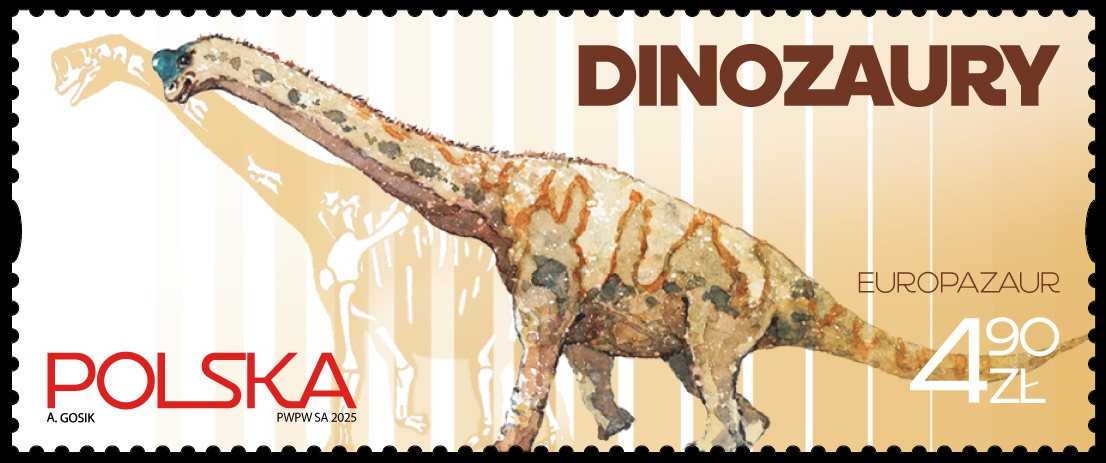 |
| Europasaurus on stamp of Poland 2025. |
The species represents a remarkable example of insular dwarfism, having evolved from a sauropod population that became isolated on an island within the Jurassic Lower Saxony Basin. Discovered in the Langenberg Quarry near Oker, close to Goslar in Lower Saxony, Europasaurus provided important evidence for evolutionary adaptation among sauropods living in restricted island environments.
Germany occupies a particularly important place in the history of paleontology.
 |
| Archaeopteryx on "150 years of discovery prehistoric bird Archaeopteryx" stamp of Germany 2011. |
German paleontology has also played a central role in the development of the discipline itself. From early studies of fossil reptiles and the discovery of Archaeopteryx to the giant dinosaurs of Tendaguru, Ernst Stromer's expeditions to Egypt, and the exceptional fossils of the Grube Messel, German scientists, museums, and universities have contributed significantly to paleontological research for more than two centuries. Their achievements extend beyond individual discoveries to major advances in evolutionary biology, phylogenetic systematics, palaeoecology, and palaeoneurology, fields that continue to influence modern paleontological research worldwide.
What This Article Covers
This article traces the development of German paleontology from its origins in the eighteenth century to the present day. It follows the scientists, museums, fossil localities, and expeditions that established Germany as one of the world's leading centres of paleontological research, while also examining the effects of war, political change, and scientific transformation on the discipline.
Along the way, readers will encounter some of the world's most celebrated fossil discoveries, including Plateosaurus, Archaeopteryx, Spinosaurus, and the dinosaurs of Tendaguru, as well as the pioneering work of Hermann von Meyer, Eberhard Fraas, Ernst Stromer von Reichenbach, Tilly Edinger, Willi Hennig, Adolf Seilacher, and many other scientists whose research transformed our understanding of prehistoric life. The article also highlights the enduring importance of Germany's natural history museums and research institutions, whose collections continue to produce new discoveries through modern analytical techniques.
More than a chronological account, this is the story of how German paleontology developed from the description of remarkable fossils into a multidisciplinary science combining geology, biology, ecology, biomechanics, and advanced analytical technologies to reconstruct evolution and ancient ecosystems through deep geological time. It is also a story of scientific curiosity, international cooperation, and the preservation of a remarkable natural heritage that continues to inspire both researchers and the public alike.
An appendix provides a guide to Germany's principal national, regional, and local paleontological museums, fossil collections, and geological visitor centres, offering readers a practical resource for exploring this scientific heritage first hand.
Basic Terms
What is paleontology?
 |
| One of two stamps from "Science" of Spain 2012 was dedicated to paleontology. |
It includes the study of fossils to determine organisms' evolution and interactions with each other and their environments (their paleoecology). The term itself originates from Greek palaios, "old, ancient", on "being, creature" and logos "speech, thought, study".
In other words, Paleontology or Palaeontology, is a science about extinct animals based on the fossil record.
The main goal of Paleontology is reconstruction of life's evolution on Earth, and to understand its origin and development.
Who are paleontologists?
Scientists who study fossils are called Paleontologists or Palaeontologists.
Paleontologists dig for fossils in the field, bringing them to universities, labs or museums to study them.
 |
 |

|
|

|
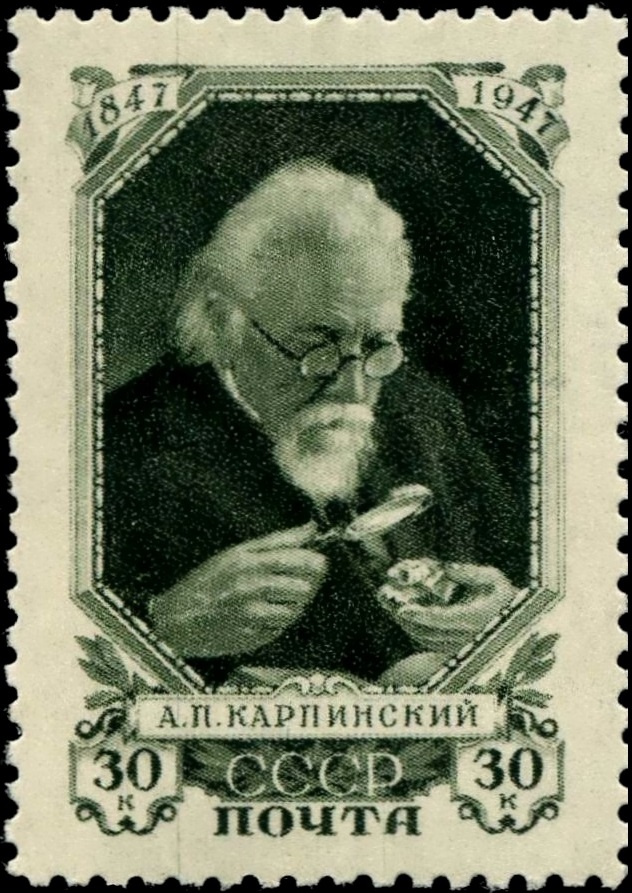
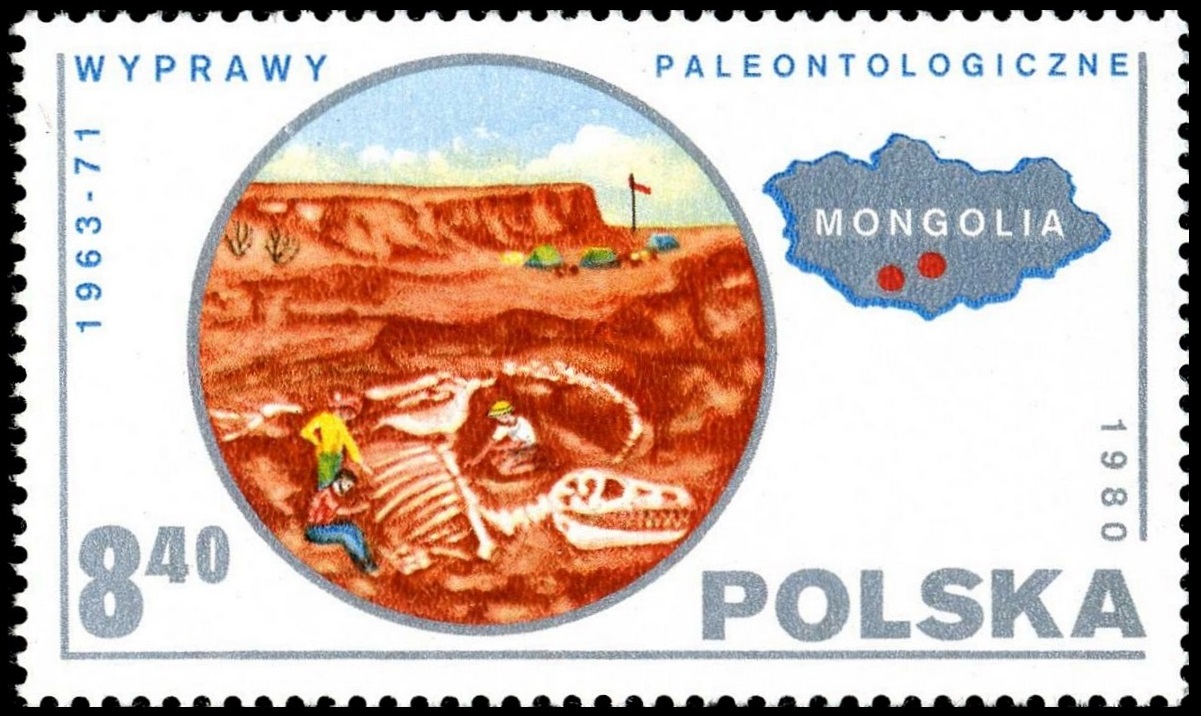
| Mix of stamps, not scaled, showing paleontologists on work: TOP row: selvages of Mini-Sheet of Malawi 1993, Soviet Union 1947. ABOVE: Souvenir-Sheet of Uganda 1995, stamp of Poland 1980, stamp of New Zealand 1984 | ||
Although dinosaurs are among the best-known prehistoric animals, paleontologists study every form of ancient life, including microorganisms, plants, invertebrates, fishes, amphibians, reptiles, birds, mammals, and traces of ancient activity preserved in rocks. Their research contributes not only to evolutionary biology but also to geology, ecology, climatology, and the understanding of Earth's history.
Related Science: paleontology, Geology, Archaeology, and Palaeoanthropology
Paleontology is closely connected with Geology because fossils are preserved primarily within sedimentary rocks, whose age, origin, and formation are studied by geologists. Understanding the geological context of a fossil is essential for determining its age, reconstructing ancient environments, and understanding the processes that led to fossil preservation.

Paleontology is often confused with Archaeology, but the two disciplines investigate different aspects of the past. Archaeology studies human history through artefacts, buildings, settlements, and other traces of human activity, generally from the appearance of the first stone tools to historical times. paleontology, in contrast, investigates fossil organisms throughout Earth's history, from the earliest evidence of ancient life more than 3.5 billion years ago to the animals and plants of the Ice Age.

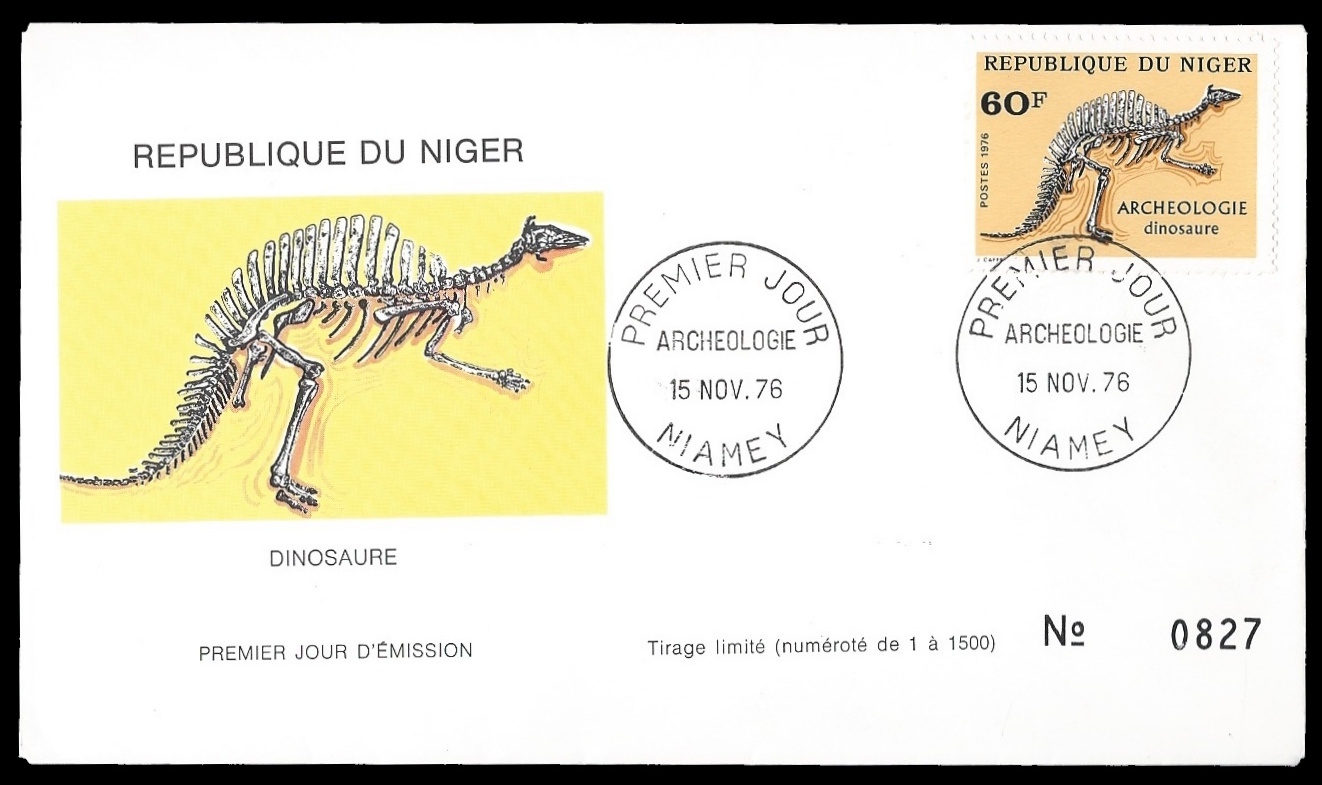
The single stamp issue of Abkhazia from 2019 called "Archaeology of Abkhazia", while depicts an Ammonite rather than any human artefacts.

Between these disciplines lies Palaeoanthropology, the scientific study of human evolution.
Palaeoanthropologists investigate fossil humans and their extinct relatives, including early members of the genus Homo, Australopithecus, and other hominins, together with archaeological evidence of human behaviour. Because this field combines fossil research with the study of human origins and culture, it draws upon paleontology, archaeology, geology, anthropology, genetics, and evolutionary biology.
Germany has played an important role in the history of palaeoanthropology through several discoveries that shaped
the scientific understanding of human evolution.
The most famous example is the discovery of the Neanderthal remains in 1856 in the Neander Valley
(Neandertal) near Wuppertal and Mettmann, not far away from Düsseldorf.
The fossil remains, initially recognised as belonging to an extinct human form, became one of the most important
discoveries in the study of human evolution and gave its name to the species Homo neanderthalensis.
Other important German finds include the Middle Palaeolithic remains from sites such as Ehringsdorf near Weimar, where Neanderthal fossils were discovered in the early twentieth century, and the extensive archaeological research carried out at prehistoric sites throughout Germany.
The Caves and Ice Age Art in the Swabian Jura (Höhlen und Eiszeitkunst der Schwäbischen Alb), recognised as a UNESCO World Heritage Site in 2017, provide exceptional evidence of early modern human culture. The caves of the Swabian Alb contain some of the world's oldest known figurative artworks, musical instruments, and personal ornaments, dating to the Aurignacian period around 40,000 years ago. These discoveries contributed significantly to the study of human evolution, migration, adaptation, and symbolic behaviour during the Pleistocene.
Although palaeoanthropology overlaps with paleontology through the study of fossil remains, the evolution of humans, prehistoric archaeology, and related discoveries form a separate field of research and are beyond the scope of this article, which focuses on the development of paleontology and the study of fossil life in Germany.
 |
| The skull discovered in the Neander Valley on German stamp "150 years of discovery of Neandertaler" issued in 2006. |
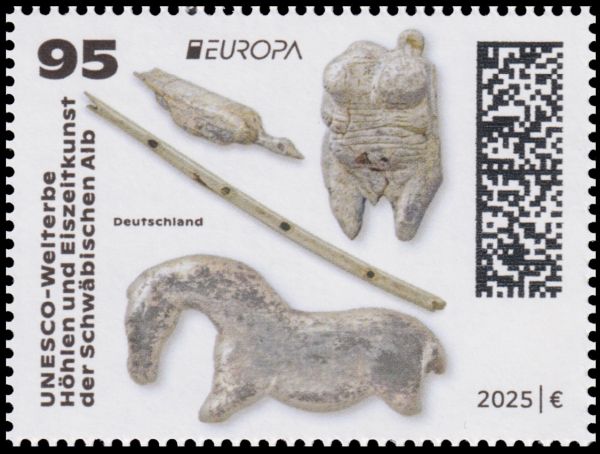 |
| The Caves and Ice Age Art figures on German stamp from 2025 "Europa 2025 - National Archaeological Discoveries - UNESCO World Heritage Site - Caves and Ice Age Art of the Swabian Alb". |
Other important German finds include the Middle Palaeolithic remains from sites such as Ehringsdorf near Weimar, where Neanderthal fossils were discovered in the early twentieth century, and the extensive archaeological research carried out at prehistoric sites throughout Germany.
The Caves and Ice Age Art in the Swabian Jura (Höhlen und Eiszeitkunst der Schwäbischen Alb), recognised as a UNESCO World Heritage Site in 2017, provide exceptional evidence of early modern human culture. The caves of the Swabian Alb contain some of the world's oldest known figurative artworks, musical instruments, and personal ornaments, dating to the Aurignacian period around 40,000 years ago. These discoveries contributed significantly to the study of human evolution, migration, adaptation, and symbolic behaviour during the Pleistocene.
Although palaeoanthropology overlaps with paleontology through the study of fossil remains, the evolution of humans, prehistoric archaeology, and related discoveries form a separate field of research and are beyond the scope of this article, which focuses on the development of paleontology and the study of fossil life in Germany.
References
| Paleontology | Geology | Paleoanthropology | Archaeology |
Related articles of this website
- Paleontology definition
- History of Paleontology
- Paleoanthropology definition
- History of Paleoanthropology