History of paleontology in Germany
Part 2: From Antiquity to the Renaissance - The Early History of Fossil Studies
The earliest encounters with fossils date back to prehistoric times
Long before fossils were studied scientifically, prehistoric humans encountered and sometimes deliberately collected them. Their unusual appearance may have made them objects of interest, and archaeological finds show that some fossils were transported, worn, or incorporated into personal ornaments.
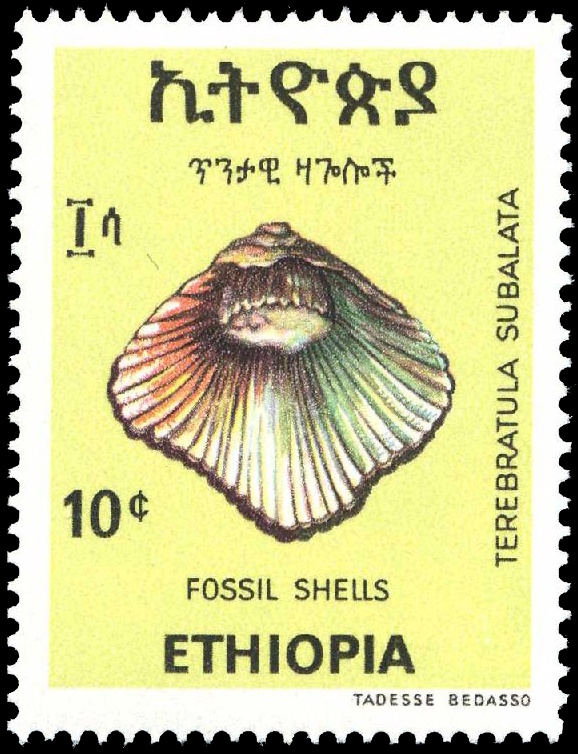 |
| Fossil brachiopod of the genus Terebratula on stamp from the "Fossil shells" set of Ethiopia 1977. |

During the Upper Palaeolithic (45,000–12,000 years ago), the use of fossils and shells as personal ornaments becomes more clearly documented. At Hohle Fels near Schelklingen, Gravettian (ca. 34,000–30,500 cal. years ago) and Magdalenian (ca. 16,500–14,500 cal. years ago) layers have yielded perforated teeth, fossilised molluscs, snails, and shells that were used as ornaments or attached to clothing.

Image source: "Lithic Raw Material Economies in Late Glacial and Early Postglacial Europe", edited by Lynn E. Fisher and Berit Valentin Eriksen, after Mauser (1970).
Ammonites and fossilised molluscs are among the unusual objects represented in the site's prehistoric ornament assemblages.
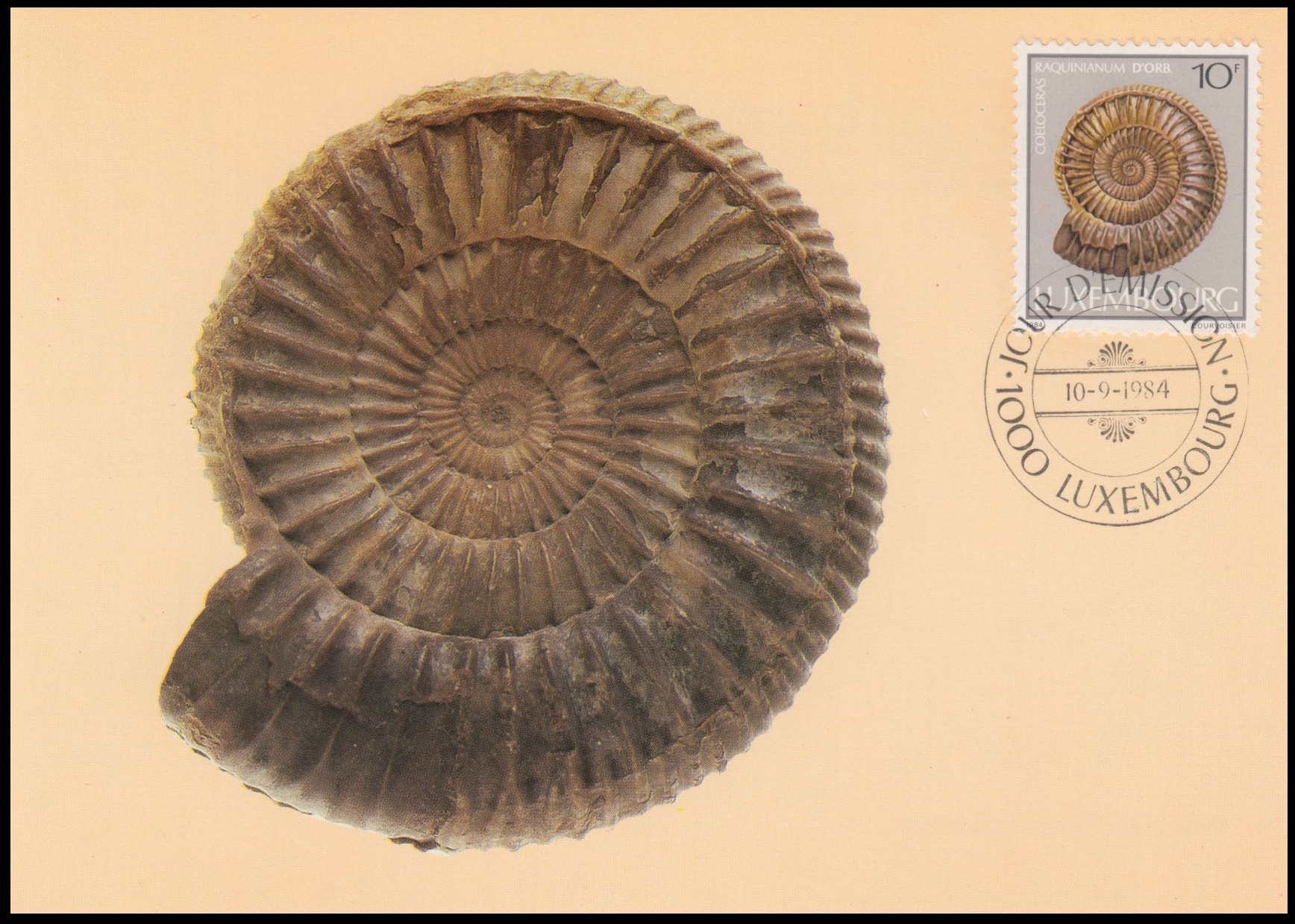 |
| Ammonite Coeloceras raquinianum on a Luxembourg 1984 Maxi Card. Coeloceras raquinianum has a diameter of 3.3 cm. When the middle of the fossil is naturally hollowed out or drilled through, it can be worn as a pendant. |
These finds provide evidence that fossils were not merely encountered accidentally. Some were deliberately selected, transported, perforated, worn, or imitated, indicating that unusual natural objects could acquire cultural and symbolic significance long before the emergence of paleontology as a scientific discipline.
Fossils interpretations in Ancient Greece
 |
 |
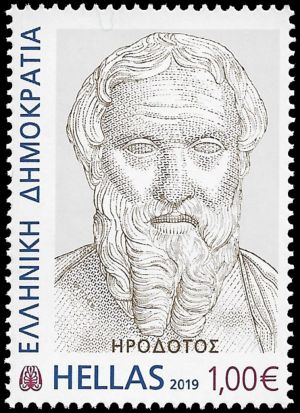 |
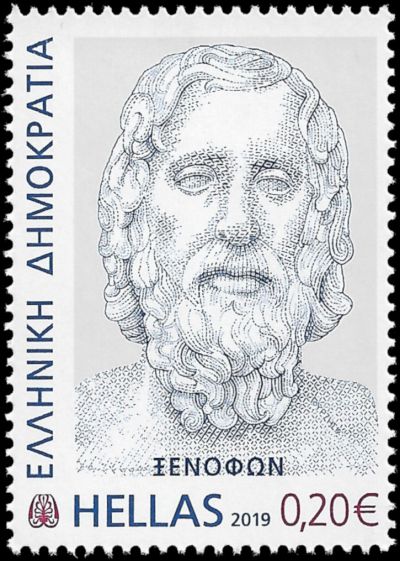
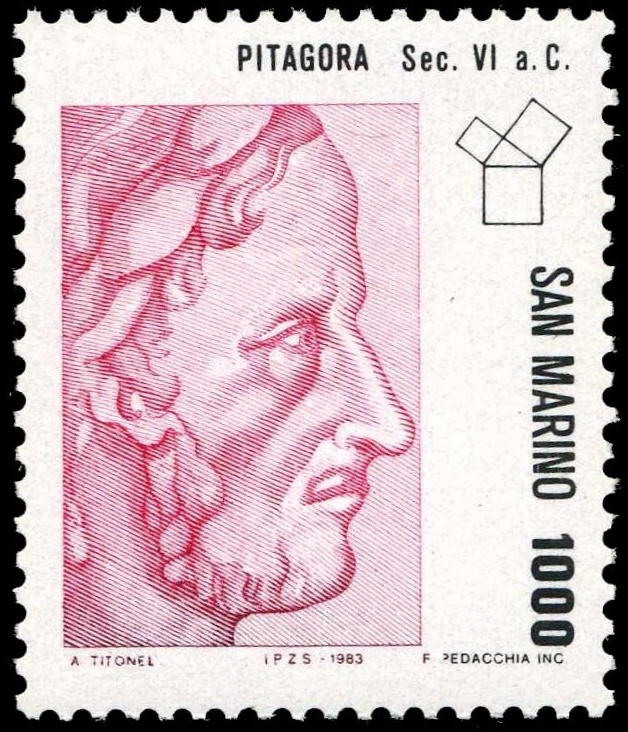
| Xenophanes on stamp of Greece 2019 MiNr.: 3042, Scott: 2879 | Pythagoras on stamp of San Marino 1983 MiNr.: 1275, Scott: 1045 | Herodotus on stamp of Greece 2009 MiNr.: 3044, Scott: 2881 |
The Greek historian Herodotus (c. 484–425 BCE) observed fossilized seashells and marine remains in the mountains of Egypt and Libya and suggested that these regions were once covered by seawater, supporting the idea that the landscape had changed over time.
The Greek philosopher Empedocles (c. 495–435 BCE) proposed that land and sea had changed places multiple times in Earth's history. While his ideas were more mythical than scientific, they implied an understanding that fossils in mountains could be evidence of past marine environments.
Aristotle and spontaneous generation
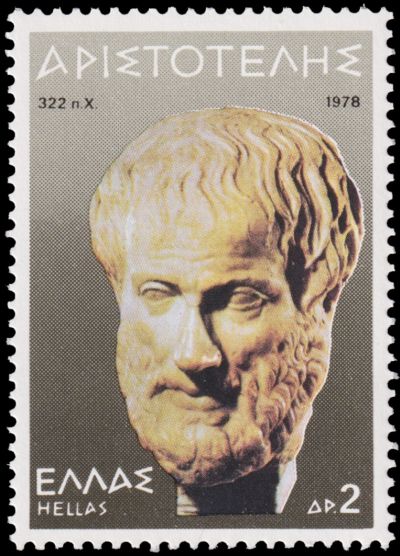 |
| Aristotle on one of the stamps of Greece 1978 - "2300th Anniversary of the Death of Aristotle" MiNr.: 1316, Scott: 1257. |
Aristotle's explanation invoked a form of natural or “vital” heat as an active principle in the generation and transformation of organic matter. His ideas about the Earth, however, were more dynamic than his theory of spontaneous generation might suggest. In his Meteorologica, he recognized that rivers change their courses, seas invade and retreat from the land, and areas that were once sea may later become dry land. He also observed that such changes occur so slowly compared with the duration of human lives that they may go unnoticed or be forgotten.
Although Aristotle did not specifically interpret fossils as the remains of once-living organisms, his authority throughout the Middle Ages contributed to the persistence of ideas about natural formation. Later thinkers could apply concepts related to spontaneous generation and the formative powers of the Earth to fossil objects, which were sometimes regarded as structures that had formed naturally within the rocks.
 |
|
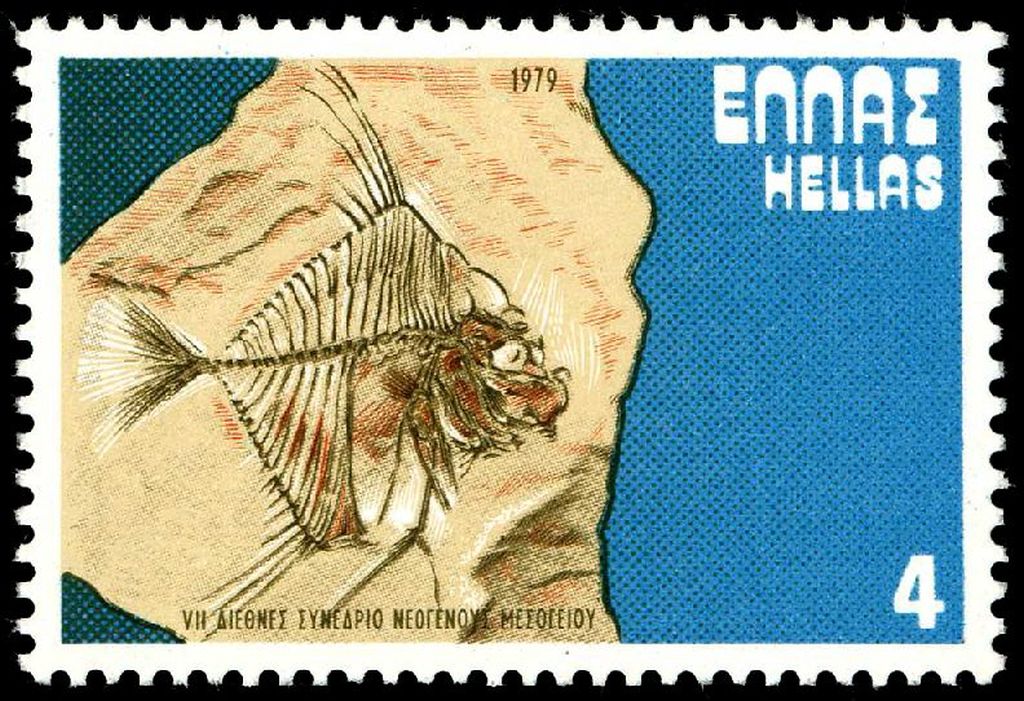
The Greek stamp issued in 1979 depicts the holotype of Mene psarianosi Symeonidis,
from the collection of the Paleontology and Geology Museum of the University of Athens,
MiNr.: 1357, Scott: 1298. The fish had a body length of approximately 7.5 cm from head to tail and lived during the Late Miocene (Tortonian, approximately 11.6–7.2 million years ago). |
Avicenna and petrifying power
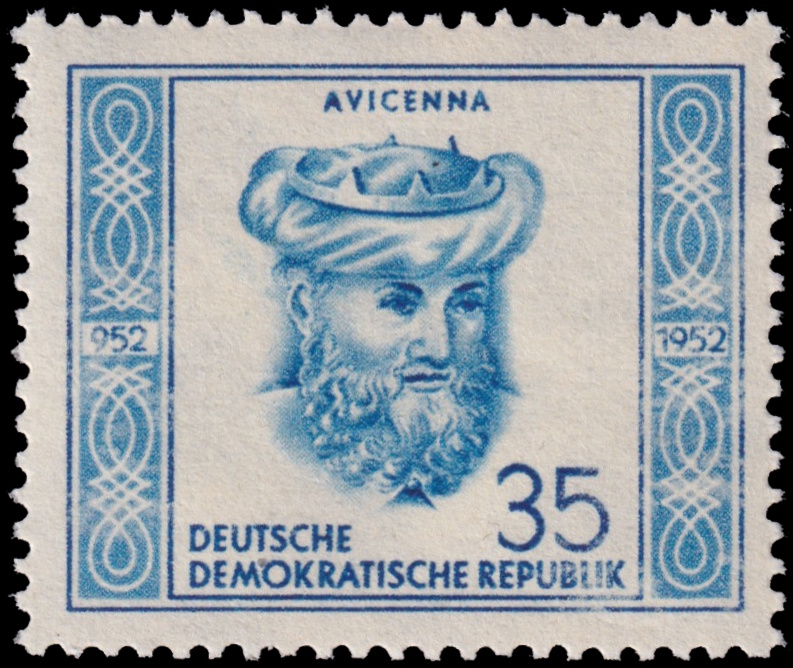 |
| Ibn Sina, known in the West as Avicenna on stamp of German Democratic Republic 1952 MiNr.: 314, Scott: 106. |
Avicenna also followed the Aristotelian tradition in explaining the formation of stones through natural forces. He referred to an unknown petrifying power, the vis lapidificativa, which could transform the bodies of animals and plants into stone. This concept can be understood as an attempt to explain the transformation of organic material into mineralized matter, corresponding in part to what is now termed fossilization.
Avicenna's combination of geological reasoning with a natural explanation for petrification was transmitted to medieval Western scholars, particularly through Latin translations of his works. Albertus Magnus was among those who drew upon Avicenna's ideas when discussing minerals, stones, and fossilized organisms. His writings therefore formed an important link between ancient and Islamic natural philosophy and the later development of European approaches to fossils and the geological history of the Earth.
Albertus Magnus and Medieval Ideas about Fossils and Life
In his De mineralibus (Book of Minerals), composed in the mid-thirteenth century, Albertus Magnus (1193–1280) discussed stones bearing the forms of animals and plants. Following the Persian scholar Avicenna, he accepted that at least some such objects represented the petrified remains of organisms that had lived in the past. He thus recognized a connection between fossil forms and former living organisms, although his explanation of their formation and preservation differed fundamentally from that of modern palaeontology.
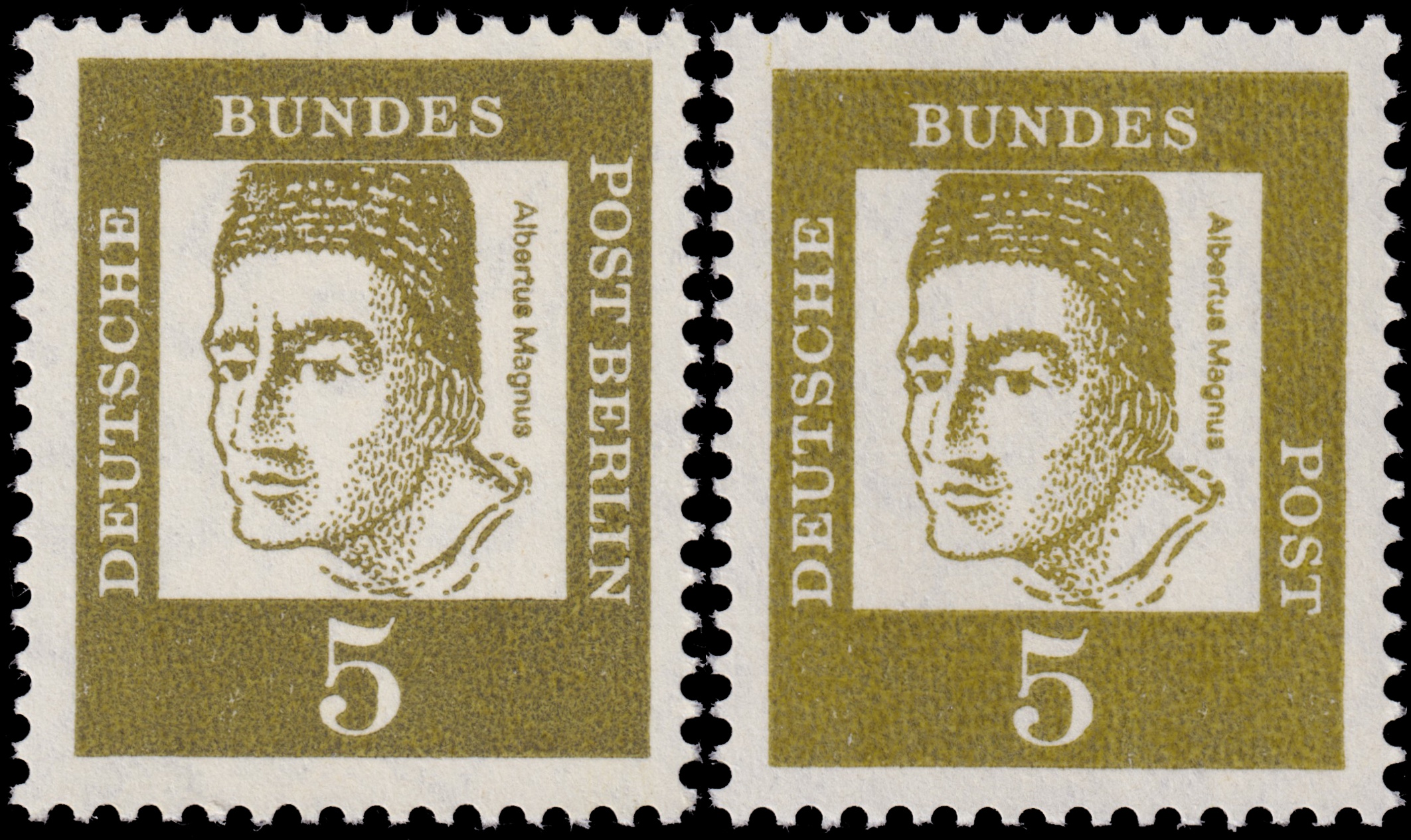 |
| Albertus Magnus on stamps of West Berlin and German Federal Republic 1961 MiNr.: 199, 347 ; Scott: 9N176, 824. |
His extensive writings covered minerals, stones, plants, animals, and other aspects of the natural world. Drawing on Aristotle, Avicenna, and other earlier authorities, Albertus Magnus also emphasized the importance of observation and the direct study of nature. His works therefore represent an important stage in the development of medieval natural history, in which ancient knowledge was combined with observations and interpretations of the natural world.
Magnus is considered one of the greatest medieval philosophers and thinkers. The Catholic Church distinguishes him as one of the Doctors of the Church. He was canonized in 1931, he was known during his lifetime as Doctor universalis and Doctor expertus; late in his life the sobriquet Magnus was appended to his name.
Albertus Magnus explained fossilized remains through natural processes operating within the Earth. He accepted that some fossil objects were the remains of animals and plants that had lived in the past, which could subsequently be transformed into stone by a mineralizing or petrifying power. This process could alter the substance of the organism while preserving its original form, allowing recognizable anatomical features to remain visible in the resulting stone.
 |
| “Impression” miniature sheet with stamps depicting petrified wood, from Austria’s “Opalised Fossils” set issued in 2020, MiNr. 5195I; Scott 5191. |
A remarkable example attributed to Albertus Magnus illustrates how such formative powers were invoked to explain unusual fossil objects. He reportedly described a stone specimen consisting of a tree branch bearing a bird's nest with birds—the entire structure having apparently been transformed into stone. The phenomenon was explained through the Aristotelian vis formativa, or formative power, conceived as a natural force capable of producing and transforming structures within the Earth.
Although such interpretations differed fundamentally from the modern understanding of fossilization, they demonstrate how medieval natural philosophers sought logical explanations for extraordinary, fossil-like objects. Albertus Magnus thus combined the recognition of fossilized remains of formerly living organisms with an Aristotelian framework of natural formative forces.
His interpretation remained firmly rooted in medieval Aristotelian and Avicennian natural philosophy, with its concepts of matter, form, and mineralizing forces. Nevertheless, it represents an important stage in the development of natural explanations for fossil remains.
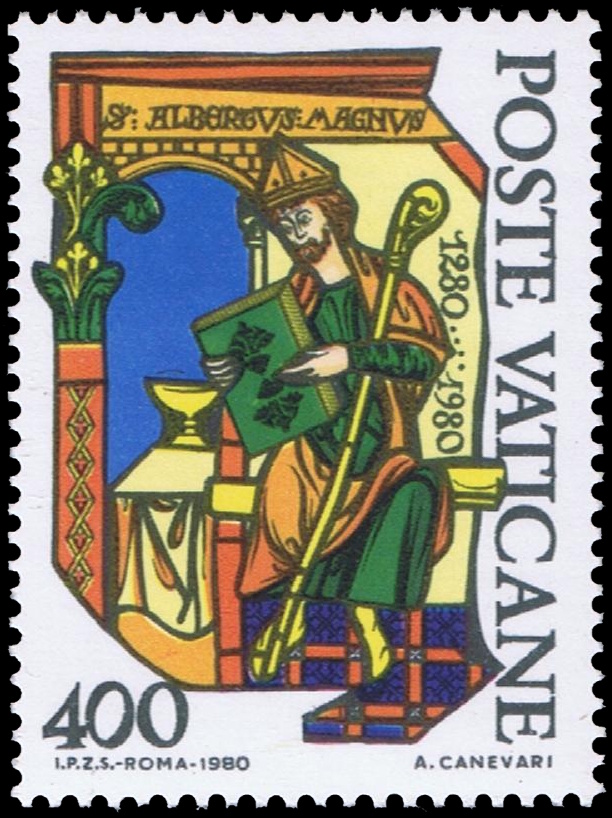
|
| Albertus Magnus on stamp of Vatican 1980, MiNr.: 778, Scott: 678. |
Albertus Magnus also worked within the Aristotelian tradition of spontaneous generation, according to which certain organisms could arise naturally without reproduction from organisms of the same kind. This concept concerned the generation of particular organisms and should not be confused with modern theories regarding the origin of life. Nevertheless, it illustrates the broader medieval effort to explain biological and geological phenomena through natural causes rather than exclusively through supernatural intervention.
His discussion of fossilized organisms is therefore significant in the history of paleontology. By the 13th century, some natural philosophers recognized a clear connection between fossil forms and organisms that had once been alive, even though the processes proposed to explain their preservation were very different from those recognized by modern paleontology.
Georgius Agricola and the Renaissance Concept of “Fossils”
One of the most important early steps toward the systematic study of fossils was made by the German scholar Georgius Agricola (1494–1555). In his De natura fossilium, published in 1546, he attempted to classify the many natural objects encountered in mines and quarries. His concept of fossilia, however, was considerably broader than the modern meaning of “fossils”: it included minerals, rocks, unusual stones, and the petrified remains of plants and animals.
 |
| Georgius Agricola on stamp of German Democratic Republic 1955, MiNr.: 497, Scott: 271. |
His De natura fossilium, published in 1546, was one of the earliest systematic works devoted to the classification and description of minerals, rocks, and other natural objects. His pioneering contributions to mineralogy have earned him the title “father of mineralogy” and made him an important precursor of modern geology.
Agricola is perhaps best known for his twelve-book treatise De re metallica, published posthumously in 1556. Based largely on direct observation and practical experience, it provided a comprehensive account of sixteenth-century mining and metallurgy, covering ore deposits, mining techniques, mineral processing, metal extraction, and the technologies employed by miners and metallurgists.
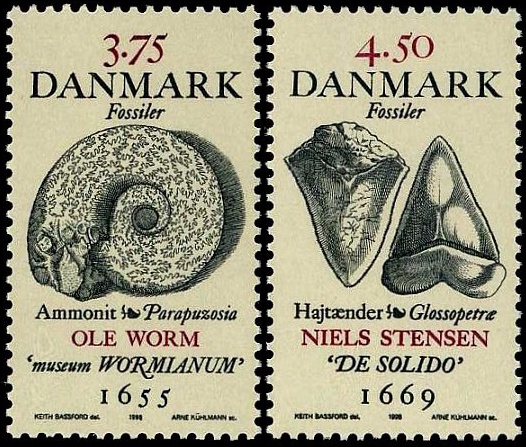 |
| Ammonite and Glossopetrae on "Drawings of fossil animals from old books" stamps of Denmark 1998, MiNr.: 1195, 1196; Scott: 1106, 1107. |
 Glossopetrae were long thought to be “tongue stones” until, in 1667,
Danish scientist and Catholic bishop Niels Stensen (1638–1686)
(Latinized to Nicolas Steno) demonstrated that they were fossilized shark teeth.
After dissecting the head of a large shark caught by fishermen near Livorno the previous year,
Steno noted that its teeth closely resembled the fossil objects known as glossopetrae or
“tongue stones”. He recognized these objects as the fossilized teeth of sharks that had
once lived, leading him to investigate how the remains of organisms could become enclosed within solid rocks.
Glossopetrae were long thought to be “tongue stones” until, in 1667,
Danish scientist and Catholic bishop Niels Stensen (1638–1686)
(Latinized to Nicolas Steno) demonstrated that they were fossilized shark teeth.
After dissecting the head of a large shark caught by fishermen near Livorno the previous year,
Steno noted that its teeth closely resembled the fossil objects known as glossopetrae or
“tongue stones”. He recognized these objects as the fossilized teeth of sharks that had
once lived, leading him to investigate how the remains of organisms could become enclosed within solid rocks.The stamp is from Denmark 1969, MiNr.: 485; Scott: 462. |

For those remains that he accepted as genuinely organic in origin, including fossil leaves, wood, bones, and fish, Agricola sought to explain how organic material could become stone. He proposed a succus lapidescens, or “petrifying juice,” associated with water, which he believed could penetrate organic remains and transform them into stone. His interpretation therefore combined the recognition of genuine fossilized organisms with explanations based on the natural philosophy and mineralogy of his time.
Agricola's ideas also illustrate the transitional character of Renaissance fossil studies. The broad meaning of fossilia continued to encompass both inorganic minerals and petrified organic remains, and this usage remained influential in natural-history literature for centuries. Nevertheless, De natura fossilium represented an important step toward the systematic description and classification of natural objects and contributed to the gradual development of a more rigorous study of the Earth's former life.
References
- "Kleine Geschichte der Paläontologie", by Bernhard Ziegler, Stuttgarter Beiträge zur Naturkunde, Serie C, Nr. 19, ISSN: 0341-0161. The 34-page brochure was published with the support of the State Museum of Natural History Stuttgart and the Society for the Promotion of the Natural History Museum in Stuttgart e.V. (Staatliches Museum für Naturkunde in Stuttgart und Gesellschaft zur Förderung des Naturkundemuseums in Stuttgart e.V.)
- Der 42. Tagung der Hugo Obermaier-Gesellschaft (obermaier-gesellschaft.de)
- "History of Geology and Palæontology to the End of the Nineteenth Century", by Karl Alfred von Zittel, translated by Maria M. Ogilvie-Gordon, published by Walter Scott Ltd., London, 1901.
- “History and Methods of Paleontological Discovery”, by Othniel Charles Marsh, published in Popular Science Monthly, Vol. 16, December 1879 and January 1880.
- “The Rise and Progress of Palaeontology”, by Thomas Henry Huxley, published in Popular Science Monthly in December 1881.
- History of Paleontology at Wikipedia:
Timeline of Paleontology, History of Paleontology, List of Year in Paleontology - Evolution and Paleontology in the Ancient World at UCMP Berkeley
Personalities mentioned in the article
|
Xenophanes (c. 570–475 BCE) |
Pythagoras (c. 570-495 BCE) |
Herodotus (c. 484–425 BCE) |
Empedocles (c. 495–435 BCE) |
|
Aristotle (384–322 BCE)
|
Theophrastus ( c. 371 – c. 287 BCE) |
Avicenna (980–1037) |
Albertus Magnus (1193–1280)
|
|
Niels Stensen (1638-1686) |
Georgius Agricola (1494–1555) |