History of paleontology in Germany
Part 3: Challenging Prehistoric Folklore – Overcoming Myths and Monsters
The Creationist Milieu: Early Natural History and Biblical Narrative
With the spread of Christianity across Europe, the study of nature developed within a strongly religious intellectual milieu.
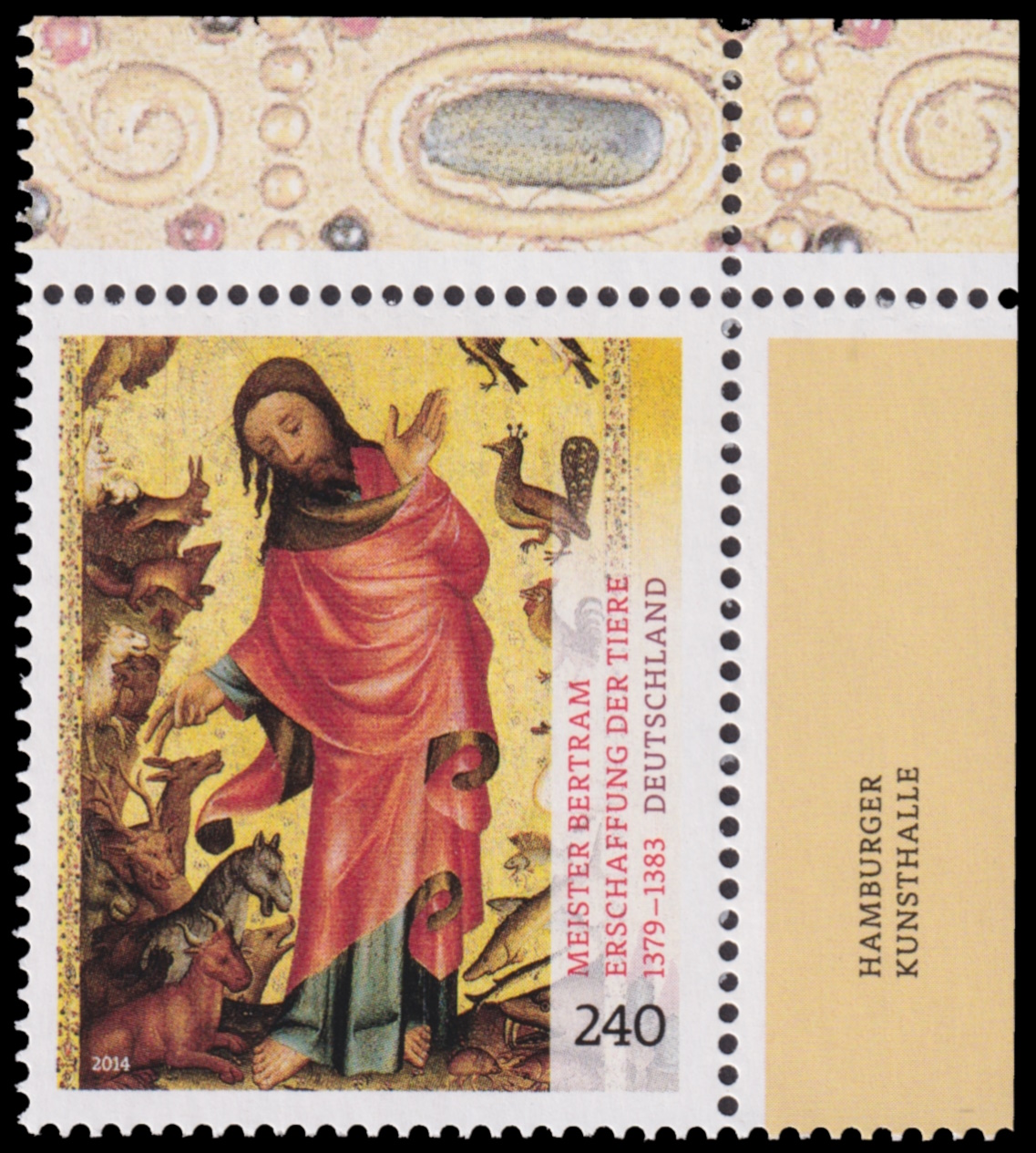 |
| God creates animals on stamp of Germany 2014 MiNr.: 3085, Scott: 2790. |
According to Christian teaching, the universe was created by God and was therefore neither eternal nor the product of chance. The Earth, the heavens, plants, animals, and humankind were understood as parts of a divinely ordered Creation, as described principally in the Book of Genesis. Life was ultimately considered to have its origin in God, with living creatures created according to the divine plan and humankind occupying a special place within Creation. Although Christian thinkers differed in how literally and chronologically they interpreted the biblical account, the idea of a purposeful divine Creation remained fundamental to the medieval Christian understanding of the natural world.

"In the beginning God created the heaven and the earth. And the earth without form and void. ... And on the seventh day God ended His work which He had made; and He rested. ... And God blessed the seventh day, and sanctified it."
The earlier fossils discoveries in Germany - 15th century
In Germany, as elsewhere in medieval and early modern Europe, fossil remains were interpreted in a variety of ways. Unusual stones and fossil forms could be regarded as products of natural processes, the remains of living organisms, or evidence of mythical creatures, such as dragon (Lindwurm) and unicorns, and biblical beings.
 |
| A giant on stamp of UK 2009, MiNr.: 2778, Scott: 2675. |
 |
| Woolly Mammoths on stamp of Switzerland 2024, MiNr.: 2970, Scott: 1989. |
When a large leg bone was discovered during the construction of the north tower of St. Stephen’s Cathedral in Vienna, Austria it was attributed to a Biblical giant. The bone was inscribed with the year of its discovery, 1443, together with Emperor Friedrich III’s “A.E.I.O.U.” maxim, and was subsequently displayed at the western portal, known as the “Giant’s Gate” (Riesentor).
A mammoth or elephant femur (hind leg bone) could easily be mistaken for that of a human giant, as it has a very similar shape,
but is much bigger, especially by someone without advanced anatomical knowledge.
In many early cases, fossils, especially small, very large or unusual object, were interpreted as fancy stones of purely mineral origin. The expression lusus naturae (“sport of nature”), became increasingly prominent in Renaissance and early modern natural history, particularly in the 16th and 17th centuries. It served as a safe way of describing anomalous geological formations whose organic origins were not yet understood, attributing their shapes to a creative mineral force within the Earth rather than ancient living organisms.
Overcoming these mineral theories formed part of a gradual, hard-fought shift toward an organic, naturalistic understanding of fossils. Naturalists increasingly compared fossil remains with the anatomy of living organisms, recorded their distinct geological occurrences, and sought explanations based on natural processes. The changing interpretation of fossils thus beautifully reflects the rocky transition from medieval and early modern accounts of extraordinary natural anomalies to the systematic study of ancient life that eventually developed into modern paleontology.
The Unicorn of Schwäbisch Hall - 1494
One of the earliest documented reports of a fossil discovery in Germany dates to 1494, when a monumental bone was unearthed in Schwäbisch Hall, Baden-Württemberg, in southern Germany. The historic episode was originally preserved in the local contemporary chronicle of Georg Widmann (1486–1560) and was later incorporated by the Protestant theologian Martin Crusius (1526–1607) into his celebrated Annales Suevici (Swabian Annals), published in Frankfurt am Main in 1596.

|
| Latin passage from page 498 of Martin Crusius's Annales Suevici (1596), documenting the 1494 discovery of the "unicorn horn" during town hall construction in Schwäbisch Hall. |
Matters of Schwäbisch Hall (Halensia quædā).
Widemann evaluates that there was once a vast wilderness around Schwäbisch Hall, and that wild beasts had a customary practice of running there to lick the salty liquid; [he infers this] from the fact that around the year 1494: (at which time the people of Hall were changing their coinage, and through their mint-master Martin Lerche were striking the coins, which are still in common use today), when excavations were being carried out underneath the new town hall (sub nova curia), a long, branchless unicorn's horn was found: a thing previously completely unprecedented in these parts.
The Unicorn's Horn (Monocerotis cornu).
The Mint-Master bought this horn from the laborers for three Florins of the new Schwäbisch Hall currency; and having divided it, he gave portions of it to others from that place.
Translated from Latin by Google AI
As the fossil has not survived, its precise nature cannot be definitively established from the surviving description. However, given that numerous fossils of Ice Age megafauna are known from the region, including the large mammoth tusk discovered in 1605 in Schwäbisch Hall, which has survived to the present day, the object discovered in 1494 and identified as a unicorn's horn likely was a tusk of woolly mammoth.
The Legend of Unicorn
The unicorn was a legendary one-horned animal whose image and attributes developed from ancient accounts of real animals, medieval folklore, and later interpretations of unusual natural objects. Ancient writers, including Ctesias (c. 400 BCE), described a one-horned animal associated with India, probably drawing in part on the Indian Rhinoceros (Rhinoceros unicornis). In medieval Europe, the creature gradually acquired its familiar horse-like appearance, while long, spirally twisted Narwhal tusks (Monodon monoceros) came to be regarded as its genuine horns, or alicorns. |
| Unicorn on stamp of Australia 2011, MiNr: 3624I, Scott: 3579. |
 |
| Unicorn on stamp of Great Britain 2009, MiNr: 2777, Scott: 2674. |
 |
| Unicorn on stamp of Belgium 2011, MiNr: , Scott: . |
 |
| Unicorn on stamp of France 1964, MiNr: 1425, Scott: 1107. |
 |
| Unicorn of Scotland and horse of Hannover on stamp of Great Britain 1998, MiNr: 1738, Scott: . |
 |
 |
| Indian Rhinoceros on stamp of India 1962, MiNr: 346, Scott: 362. | Narwhal on stamp of Greenland 1975, MiNr: 92, Scott: 72. |
Because the horn was believed to be made of a substance called alicorn, it was attributed with magical and medicinal properties. It was believed to protect against poisoning, either by detecting or neutralizing toxins, and to cure a wide range of diseases.
Cups reputedly made of unicorn horn—but actually made of rhinoceros horn or narwhal tusk—were highly valued by important persons in the Middle Ages as protection against poisoned drinks.
Alicorn powder, made from narwhal tusks or the horns of various animals, was sold in Europe for medicinal purposes as late as 1741.
The long, spirally grooved narwhal tusk closely resembled the traditional image of the unicorn's horn and was sometimes known as the “sea unicorn”.
Narwhal tusks were consequently incorporated into royal and ecclesiastical treasures, ceremonial objects, and cabinets of curiosities (Kunstkammern) throughout Europe. In some cases, they were treated as objects of exceptional prestige. The Habsburg collections, for example, included a large narwhal tusk known as the Ainkhürn, which was believed to be the horn of a unicorn and was regarded as an inalienable heirloom of the House of Austria.
In medieval folklore and bestiary tradition, the unicorn was commonly described as a fierce and untameable creature that could not be captured by hunters through force alone.
The medieval bestiary tradition consisted of illustrated “books of beasts” that described both real and mythical animals, often combining their supposed characteristics with moral and Christian interpretations. It emerged from the Late Antique Physiologus, a text compiled by an unknown author before the middle of the 2nd century AD. It consists of stories based on the “facts” of natural science as understood by someone called Physiologus (Latin: “Naturalist”), about whom nothing further is known, combined with the compiler's own religious ideas. Bestiaries became particularly popular in Western Europe from about the 12th century onward. They were not scientific works in the modern sense, but used animals to convey religious and moral lessons.
According to bestiary accounts, the unicorn could be subdued only by a pure virgin. When it encountered her, it would approach willingly and place its head in her lap, thereby becoming vulnerable to the hunters waiting nearby.The story acquired a range of secular and courtly meanings. The unicorn's wildness and resistance to capture could be associated with purity and chastity, while the encounter between the untamed beast and the maiden also became a metaphor for courtly love and the relationship between a lover and his beloved.
At the same time, the virgin-and-unicorn story became an important Christian allegory. In the Physiologus and the medieval bestiary tradition, the unicorn was interpreted as a symbol of Christ, while the virgin represented the Virgin Mary. The animal's approach to the virgin and its vulnerability after resting in her lap were understood as an allegory of the Incarnation: Christ, taking human form through Mary, became subject to human suffering and death. The subsequent capture and killing of the unicorn could therefore be interpreted in relation to the Passion of Christ.
The combination of religious allegory, courtly symbolism, and folklore made the unicorn a versatile figure in medieval European art and literature. Its representation could convey different meanings depending on the context, ranging from chastity and courtly love to the Incarnation and Passion of Christ.
The unicorn also became an established figure in European heraldry. In heraldry, it is often depicted as a horse with a goat's cloven hooves and beard, a lion's tail, and a slender, spiral horn on its forehead. It was used in the arms of noble families and institutions and, most prominently, as a royal supporter in Scotland.
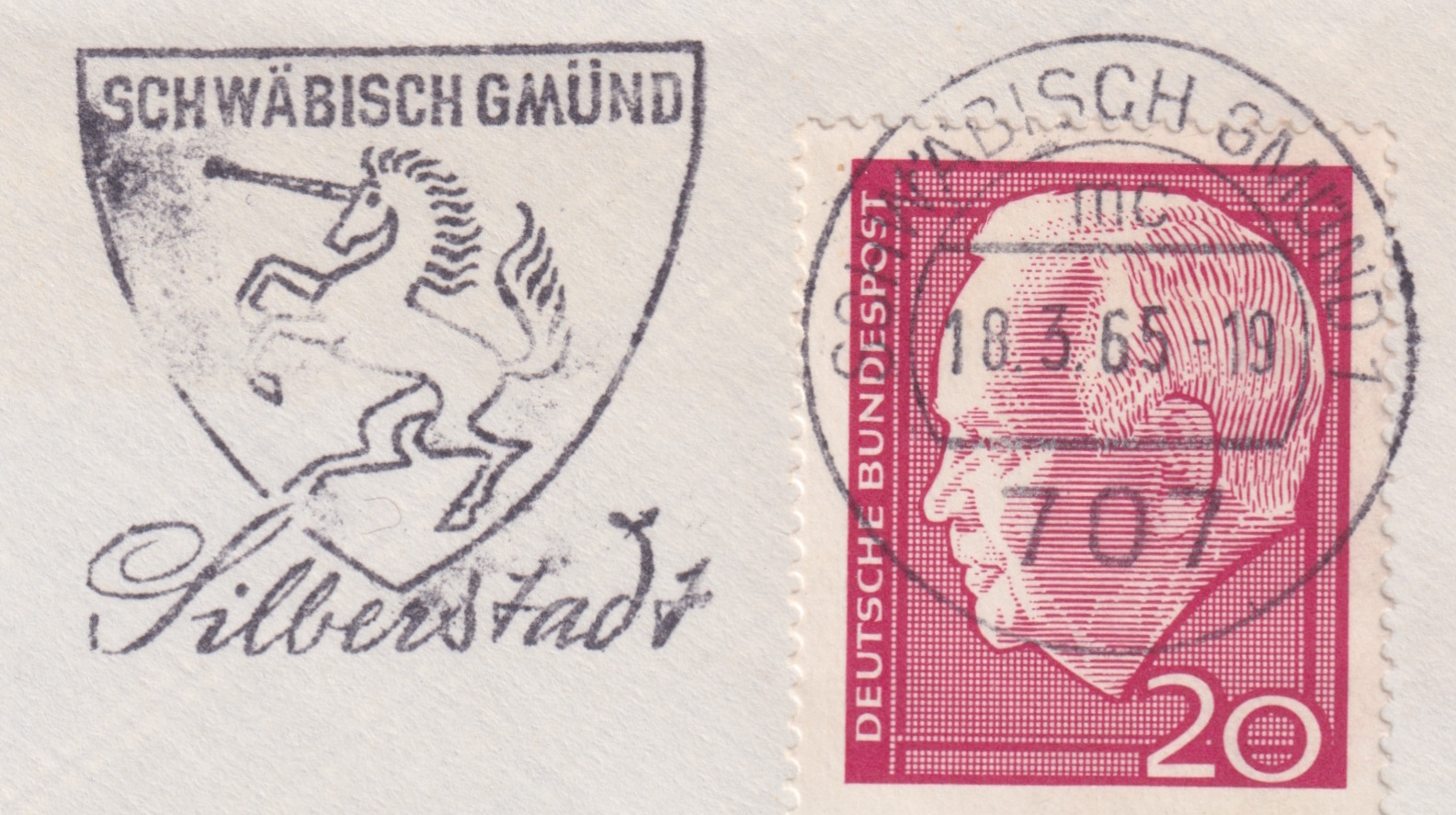
The unicorn also entered municipal heraldry, where it became an enduring symbol of several European towns. One of the earliest documented examples is Schwäbisch Gmünd, whose unicorn is regarded by the city as probably the oldest surviving municipal unicorn in the German-speaking world.
 |
|
Unicorn on a postmark of West Germany, 1965 — the coat of arms of Schwäbisch Gmünd. Schwäbisch Gmünd is known as the Gold- and Silberstadt (Gold and Silver City), reflecting its long tradition of goldsmithing, silversmithing, and jewelry production. |
During the 13th century, Schwäbisch Gmünd was closely associated with the cult of the Virgin Mary. The city's principal parish church was dedicated to Mary, and the later Heilig-Kreuz-Münster developed from this medieval ecclesiastical setting.
The precise reason why the unicorn was chosen for the city's seal is not documented. Recent research by the Stadtarchiv Schwäbisch Gmünd, however, connects the choice with the medieval allegory of the unicorn and the virgin. In this interpretation, the unicorn can be understood as a symbol associated with the city's patroness, the Virgin Mary. The Gmünd example therefore provides an early instance of how the religious symbolism of the medieval unicorn tradition could become incorporated into a municipal emblem.
The Rise of Cabinets of Curiosities and Court Collections
 |
| This 1978 DDR commemorative stamp issue celebrates the 250th anniversary of the Staatliche Wissenschaftliche Museen Dresden. The featured collections—including the biological specimens of the Museum für Tierkunde (10 & 20 Pf), the fossilized frog (Palaeobatrachus diluvianus) and agate matrix of the Museum für Mineralogie und Geologie (250 & 35 Pf), and the Enlightenment mechanical clocks and telescopes of the Mathematisch-Physikalischer Salon (40 & 50 Pf)—trace their foundational roots directly back to the natural history and mechanical wonders catalogued in Elector August of Saxony's private 1560 Kunstkammer. MiNr: 2370-2375, Scott: 1958-1963. |
 |
| Petrefakten — ammonites, shells and ichthyosaur fossils discovered at Staffelstein, near Kloster Banz, shown in the bottom-left of a Bavarian postcard mailed in 1908. |
These collections brought together rare objects from the natural world and human craftsmanship, including minerals, unusual stones, shells, fossils, stuffed animals, scientific instruments, artworks, and exotic objects from distant lands.
One of the earliest and most influential examples was the Kunstkammer of August of Saxony (1526–1586), whose court in Dresden assembled a wide-ranging collection of natural and artificial curiosities. The collecting activities of the Saxon court were closely connected with the region's rich mining tradition, especially the mineral resources of the Ore Mountains. Although these collections were not scientific institutions in the modern sense, they preserved numerous natural specimens, including fossils, and provided an important foundation for their later study.
Over time, the collecting of natural objects became increasingly systematic. Minerals, rocks and Petrefakten, the historical term for what would later be called fossils, were gradually separated from the general collections of curiosities and assembled in specialised Naturalienkabinette and Petrefakten-Sammlungen. This development marked an important transition from the Renaissance tradition of collecting natural wonders towards the systematic investigation of geological and palaeontological specimens.
The growing interest in natural objects was not limited to collecting and displaying specimens. By the late 16th and early 17th centuries, scholars also began to describe and classify the natural materials they encountered in greater detail.
Bernard Palissy and the Early Interpretation of Fossils

|
| Bernard Palissy on a French stamp, 1957, MiNr.: 1137; Scott: B313. |
Palissy based his interpretations on direct observation of fossil shells, bones, and other natural objects. He emphasized that their detailed structures corresponded closely to those of living organisms and argued that they had subsequently been buried and petrified.
His ideas were published in his major work, Discours admirables, in 1580, in which he discussed natural history, geology, and hydrology and emphasized the importance of first-hand observation. Palissy went further in his interpretation of fossil organisms, arguing that they had not simply been formed spontaneously within the Earth. He maintained that fossil shells and other remains had belonged to living organisms and had been deposited in places that had once been covered by water, including ancient seas and freshwater environments.
These ideas challenged several traditional explanations of fossils current in the 16th century. Palissy's observations and arguments represented an important early step toward a naturalistic understanding of fossils and marked a significant departure from many of the mythical and speculative explanations common in his time. His interpretation forms an important intellectual background to the more systematic observations of fossil remains that appeared in Central Europe around the end of the 16th and beginning of the 17th centuries. One of the early examples was the work of Johann Bauhin, whose observations of fossils were published in his Badbuch of 1598.
Early Observations and Illustrations of Natural Objects in the German-Speaking Lands (1602)
At the end of the 16th century, German aristocrats became increasingly interested in the therapeutic and economic potential of warm mineral springs and established state spas to exploit them. Around 1596, Duke Friedrich I of Württemberg targeted a natural sulfur spring at Bad Boll, located at the foothills of the Swabian Alb (Schwäbische Alb). Before finalizing the permanent infrastructure of the health resort, the Duke commissioned his personal physician, Johann Bauhin, to investigate the waters and surrounding environment. Following Bauhin’s successful medical validation of the spring that same year, the Duke immediately ordered his master builder, Heinrich Schickhardt, to construct the historic spa facility (Kurhaus).

|
|
Johann Bauhin (1541–1613). Image credit: Wikipedia. |

|
| Title page of the fourth volume of Historia novi et admirabilis fontis balneique Bollensis, published by Johann Bauhin in Latin in 1598. |
Johann Bauhin, latinized as Bauhinus, (1541–1613), was a distinguished Swiss physician and botanist who spent much of his career in the German-speaking duchies. Bauhin served as a personal court physician to the House of Württemberg for over forty years, remaining in office under Duke Friedrich I and his successors until his death in 1613. His detailed empirical observations of the mineral springs, plants, rocks, and fossils near Stuttgart epitomized the Renaissance movement to systematically document the natural world.
Originally published in Latin in 1598 under the title Historia novi et admirabilis fontis balneique Bollensis, the comprehensive work was structured into four distinct volumes. Conceived primarily as a prestigious scientific marketing tool to legitimize the spring's therapeutic efficacy, the text targeted different audiences over time. While the Latin original promoted the resort across Europe to the international academic and noble elite, the work was subsequently translated into German by David Förter and published in Stuttgart in 1602 to make the project accessible to the local German-speaking nobility. This domestic edition was released under the full title Ein neues Badbuch und Historische Beschreibung von der wunderbaren Krafft und Würckung des Wunderbrunnen und heilsamen Bads zu Boll (in English: “A New Resort Book and Historical Description of the Miraculous Power and Effect of the Miracle Fountain and Healing Bath at Boll”), and is today often called simply the "Badbuch".
As was common at the time, the work covered a wide variety of subjects relating to the area, including its local
traditions, flora, and mineral anomalies. The fourth volume (Liber Quartus), titled
"De lapidibus metalicisque miro naturae artificio in ipsis terrae visceribus figuratis"
(in English: "On stones and metallic objects shaped by the marvelous artistry of nature within the very bowels of the earth"),
included detailed descriptions of regional fossils.
Bauhin categorized these objects by matching their physical
profiles to familiar shapes or living counterparts: coiled ammonites were cataloged under the classical scholarly heading
Cornu Ammonis (Ammon's horns), bullet-shaped belemnite guards were systematically labeled
Belemnitae, while fossilized gastropods and bivalves were classified under names like
Strombitas and Chama.
The book remains highly significant as an early milestone in the illustration of fossils within their localized
geological setting.
While Bauhin did not interpret these specimens according to modern scientific concepts, his
meticulous records represent a foundational step toward systematic paleontology.
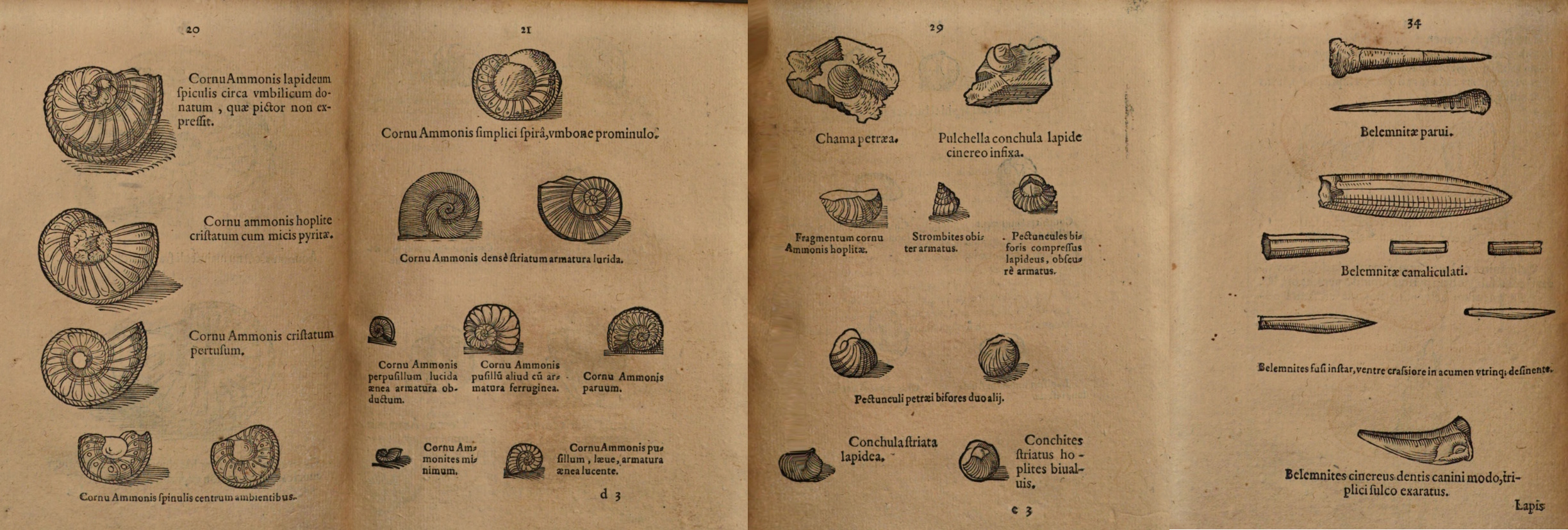
- First & Second Panels (Left): These pages focus extensively on planispiral macrofossils, featuring detailed anatomical carvings of coiled cephalopods categorized under the classical scholarly heading Cornu Ammonis (Ammon's horns), illustrating various sizes, rib densities, and whorl shapes.
- Third Panel (Center-Right): This section transitions into fossilized marine mollusks and gastropods, illustrating diverse fossil bivalve shells grouped under classical names like Chama, small helical sea snails under Strombitas, and cluster fragments of bivalve-rich limestone layers classified as Conchites.
- Fourth Panel (Far-Right): This final layout isolates elongated, pointed, and spindle-shaped internal fossils. They are systematically cataloged as Belemnitae, documenting morphological variations such as regular tapered specimens, channeled structural forms (Belemnitae canaliculati), and curved variations resembling canine teeth.
 |
| Ammonite on meter franking of the Rehabilitation Clinic in Bad Boll, Germany, 2004. |
Bad Boll remains a prominent spa and rehabilitation destination centuries after Duke Friedrich I's commission. The Rehaklinik Bad Boll (Rehabilitation Clinic Bad Boll) operates directly on the historic Kurhaus grounds and uses an ammonite in its official logo alongside stylized representations of local healing waters. This deliberate choice of symbolism highlights the clinic's deep connection to the regional landscape, where the ancient Jurassic shale layers not only contain abundant fossils but also enrich the local mud and thermal springs utilized in therapeutic treatments. By featuring this prehistoric shell, the modern facility visually honors the unique natural heritage first cataloged by Johann Bauhin in 1598.
The Mammoth Tusk of Schwäbisch Hall (1605)
More than a century after the first unicorn's horn was discovered in Schwäbisch Hall (1494), another was found directly inside the town on February 13th, 1605. This specimen has survived to this day and can be clearly identified as the tusk of a woolly mammoth. The mammoth tusk is preserved in St. Michael's Church in Schwäbisch Hall. This fossil was also originally interpreted as the horn of a mythical unicorn.
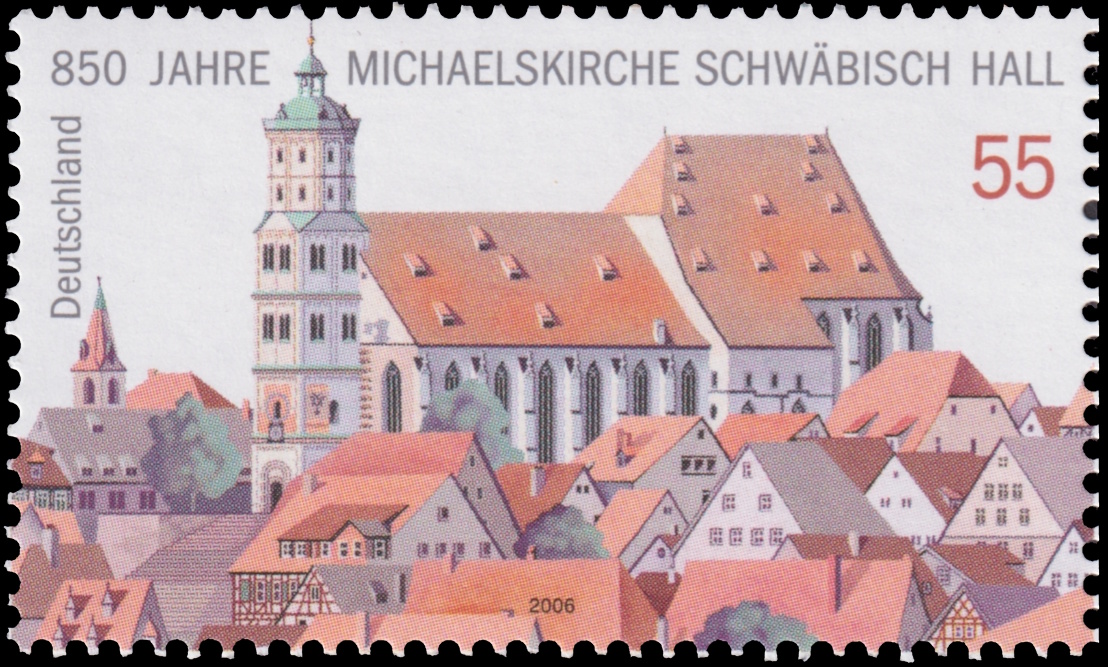 |
| St. Michael's Church on stamp of Germany 2006, MiNr: 2522, Scott: 2370. |
The public presentation of the tusk was directly entangled in a bitter, contemporary civic and theological dispute involving the controversial preacher Johann Weidner. Locked in a fierce ideological conflict with the Schwäbisch Hall magistrate, who sought to silence and dismiss him, Weidner weaponized the sensational February 1605 discovery. He framed the massive fossil as a prophetic, divine miracle sent to vindicate his strict orthodox ministry, effectively rallying public support and preventing the council from executing his immediate exile.
To permanently house the relic within the church's choir ambulatory, the town authorities suspended the tusk inside an elaborate, custom wrought-iron frame. This decorative grille incorporates two circular medallions containing heraldic, horse-like figures bearing distinctively sharp, straight single horns, mechanically reconciling traditional unicorn imagery with the heavy curvature of the fossil.
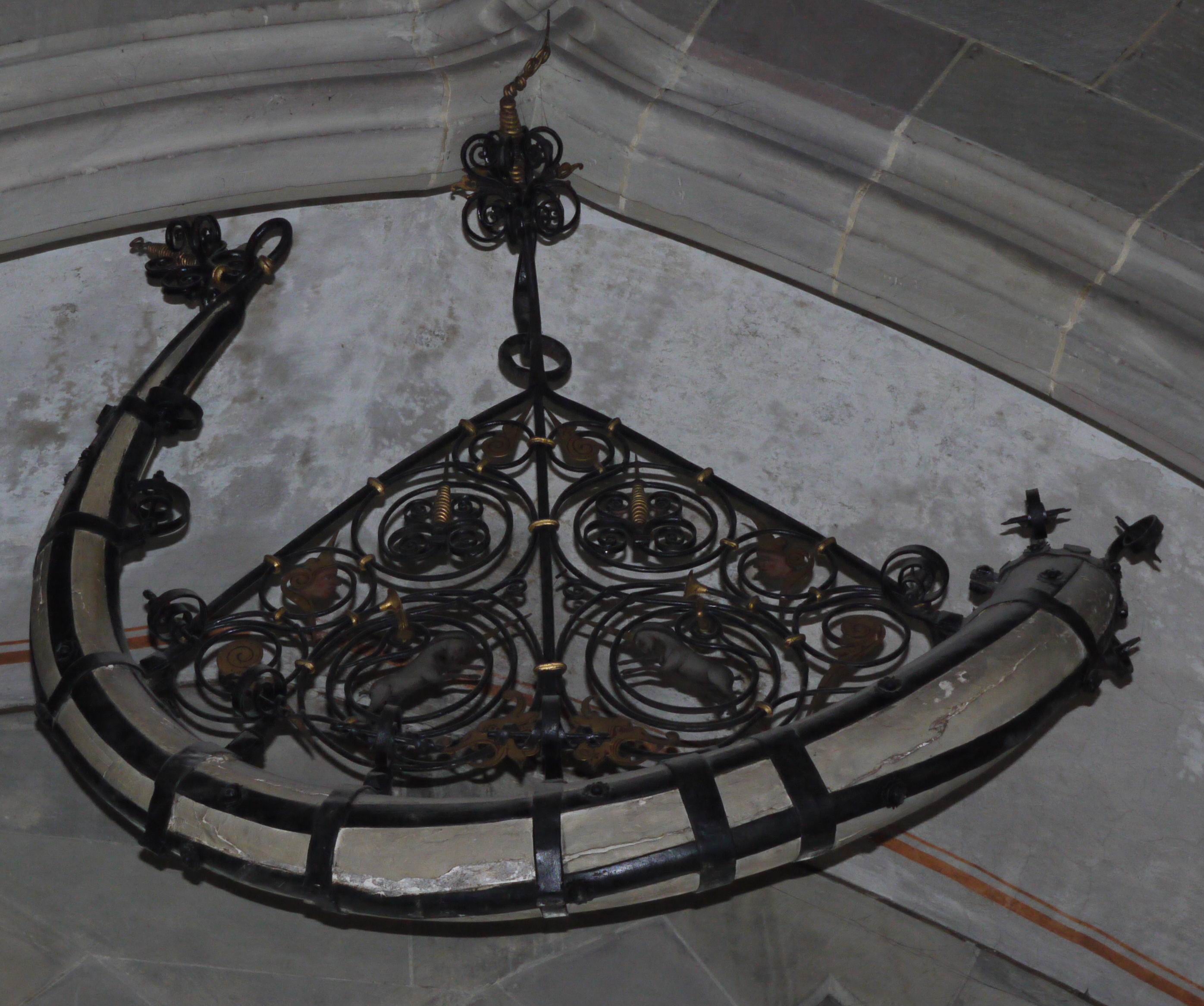
|
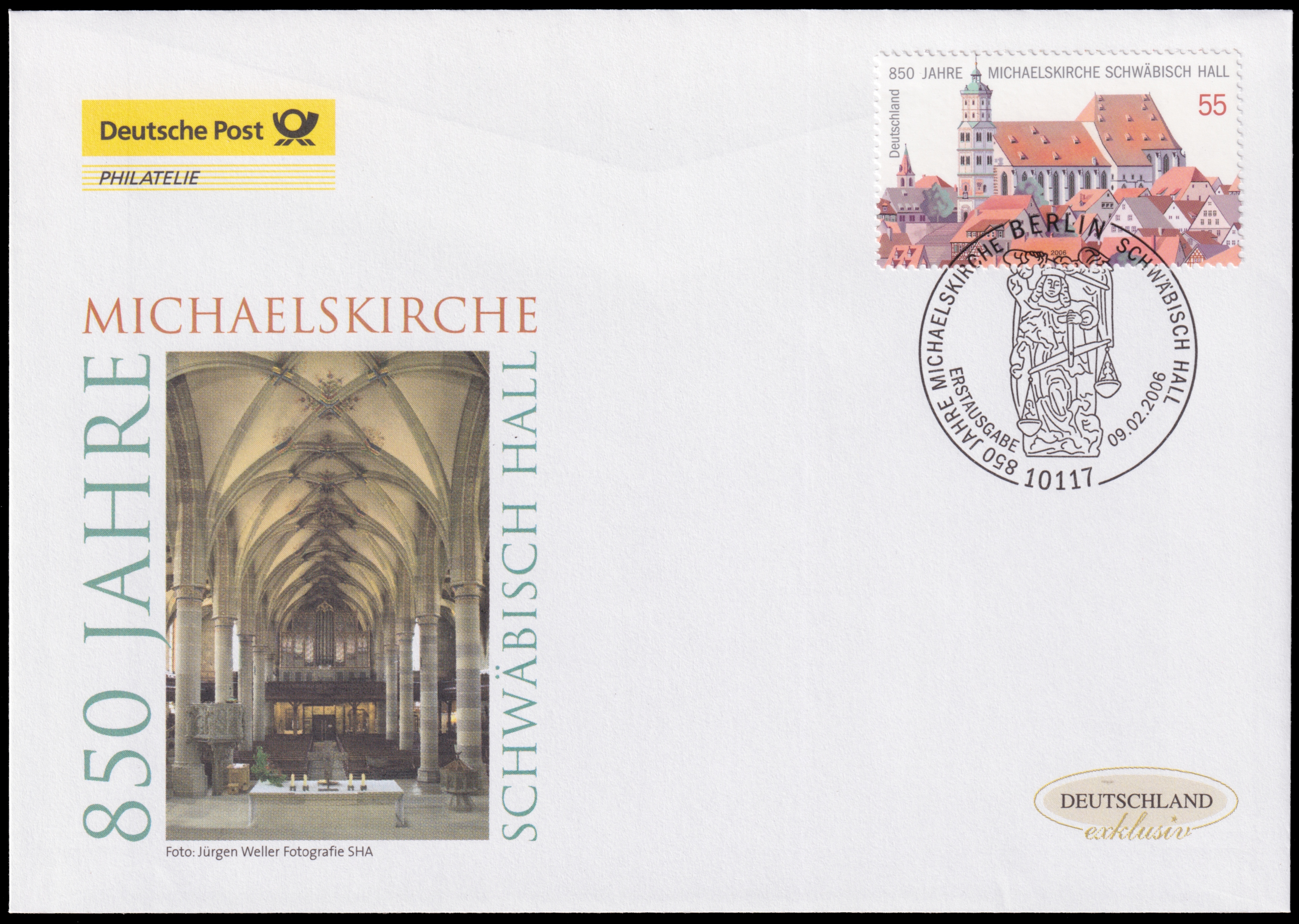
|
| The mammoth tusk from St. Michael's Church in Schwäbisch Hall. Image credit: Wikipedia. | First Day Cover (FDC) of the German Post with stamp "850th anniversary of St. Michael's Church" from 2006, featuring a cachet of the main hall of the church. The mammoth tusk, discovered in 1605, is not visible in the illustration as it is mounted on a pillar located behind the central viewpoint. |

|
|
Illustration from the title page of Johann Friedrich Beyschlag’s 1734 medical-scientific dissertation
“De ebore fossili Suevico Halensi”, printed in Halle by Johann Christian Hilliger.
The engraving provides a precise historical record of the 1605 woolly mammoth tusk as it hung inside
St. Michael’s Church in Schwäbisch Hall. The heavy curvature of the tusk is supported by an ornate
wrought-iron frame featuring decorative scrollwork and the two distinct, circular unicorn medallions used to
reconcile its biological shape with traditional lore. The composition is flanked by two prominent allegorical figures representing the integration of Enlightenment science and medicine: on the left sits Natural Philosophy (holding a celestial globe and operating an electrostatic or air-pump machine), and on the right sits Medicine / Pharmacy (holding the Rod of Asclepius and a chemical distillation vessel). The upper corners display historical shields, including the Imperial Eagle and the split arms of Schwäbisch Hall, tying the sensational fossil to the city's civic identity. |
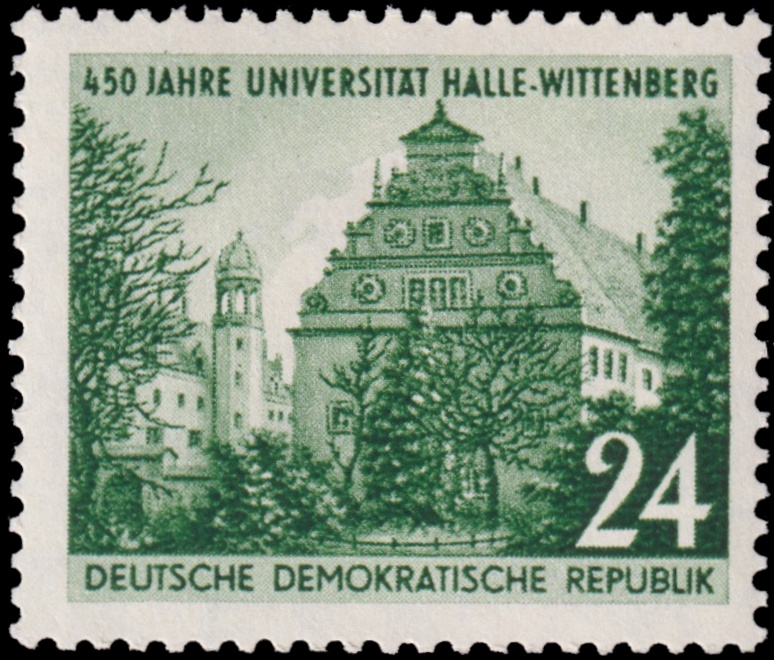
|
| German Democratic Republic stamp issued in 1952 to mark the 450th anniversary of Martin Luther University Halle-Wittenberg, depicting the historic Augusteum building in Wittenberg (MiNr: 318, Scott: 111). |
Having completed his studies at the universities of Jena and Halle before returning home to serve as a municipal physician and pharmacist, Beyschlag drafted his thesis under the supervision of the renowned Enlightenment professor Friedrich Hoffmann (1660–1742).
In his dissertation, Beyschlag provided deeper archival details about the 1605 discovery, noting that the supposed "unicorn's horn" was originally unearthed alongside numerous other fractured bones and large pieces of petrified wood. By comparing the structural composition of the "horn" to known elephant skeletons, he firmly concluded that it was an authentic elephant tusk rather than a subterranean mineral layout or the physical remains of a mythical creature.
The "Unicorn" of Quedlinburg (1663)
The most famous "Unicorn" fossil of Germany was discovered almost six decades later in Saxony-Anhalt.
In 1663, workers extracting gypsum and limestone in the Seweckenberge, in some sources spelled Zeunickenberg, located in the eastern foreland of the Harz mountains, southeast of Quedlinburg, uncovered the skeletal remains of a large animal in a fissure or cavity within the rock. The find soon became associated with the traditional concept of the Unicornu fossile, a term historically applied to various unusual fossil remains believed to belong to unicorns.
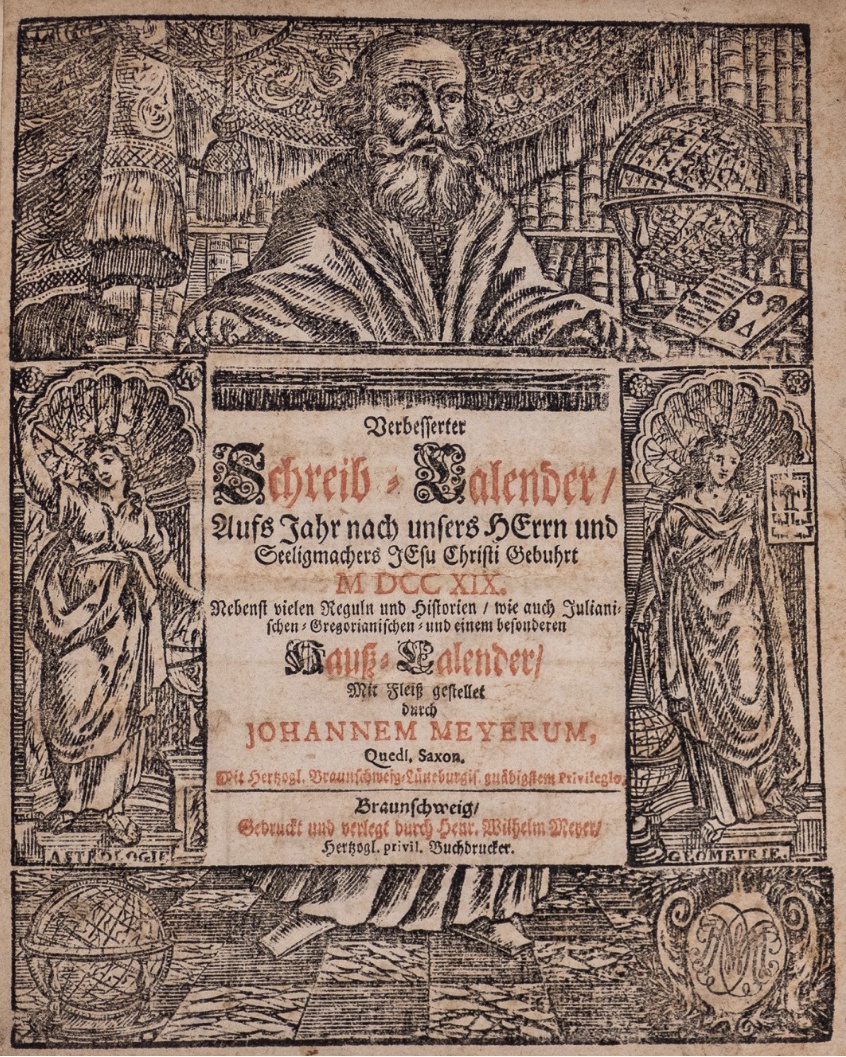 |
| Portrait of Johann Meyer (1607–1665) on the title page of his posthumously continued Schreib-Kalender (Scribbling Calendar) from 1719. The scholar is depicted in his study surrounded by scientific instruments, flanked by the allegorical figures of Astrology and Geometry. |
Johann Meyer (1607–1665) was an astronomer, mathematician, calendar maker, and civic official of Quedlinburg. His name is also found in the forms Mäyern and Mayer. Meyer was born into a clerical family and apparently studied medicine and mathematics; in the title of his 1638 calendar he described himself as Johannes Meyerus Qvedlinb. Med. Cand. & Mathem. adj. From 1636 onward, he published calendars and other astronomical writings and served as treasurer of the town, responsible for the town's finances, including the management of municipal revenues and expenditures.
It is most likely that Meyer published his account of the find, together with an accompanying illustration of the supposed unicorn skeleton, as a single-page broadside. This original work has not survived and is known today only through references in later sources. The surviving evidence nevertheless identifies Meyer as the author of the earliest known report accompanied by a figure of the Quedlinburg “unicorn” skeleton.Although the discovery was made near Quedlinburg, its early history became connected with Magdeburg through Otto von Guericke, the physicist and one of the city's mayors, whose 1672 Experimenta nova contains an account of the find.
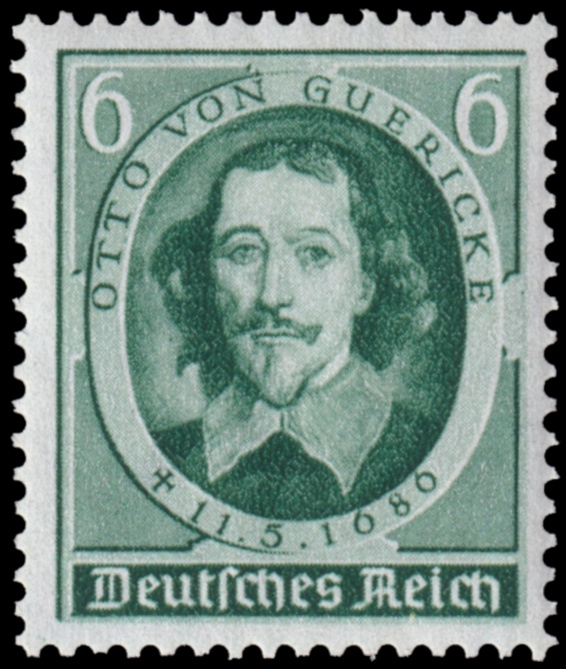 |
| Otto von Guericke on stamp of Germany 1936, MiNr: 608, Scott: 472. |
His scientific work was characterized by the use of experiment and direct observation to investigate natural phenomena, reflecting the changing approach to natural philosophy in the 17th century.
Guericke's most famous experiments involved the production of a vacuum. In his celebrated Magdeburg hemispheres experiment, he demonstrated that two closely fitting metal hemispheres could not be pulled apart when the air had been removed from inside them, illustrating the considerable force exerted by atmospheric pressure. He also carried out experiments involving air, combustion, sound, and electrical phenomena, and his work contributed to the development of experimental physics.
Guericke reported that in 1663, in a mountain near Quedlinburg known locally as the Seweckenberge, where limestone was being quarried, the skeleton of a unicorn had been found inside the rock. According to his account, the rear part of the animal lay stretched out, while the head was raised and a long horn extended forward from the forehead. The horn was described as being about the thickness of a human leg and almost 3 metres in length. Guericke further reported that the skeleton had been broken apart and removed piece by piece, with the head and horn, together with some ribs, vertebrae, and other bones, being given to the Princess-Abbess of Quedlinburg.
 |
|
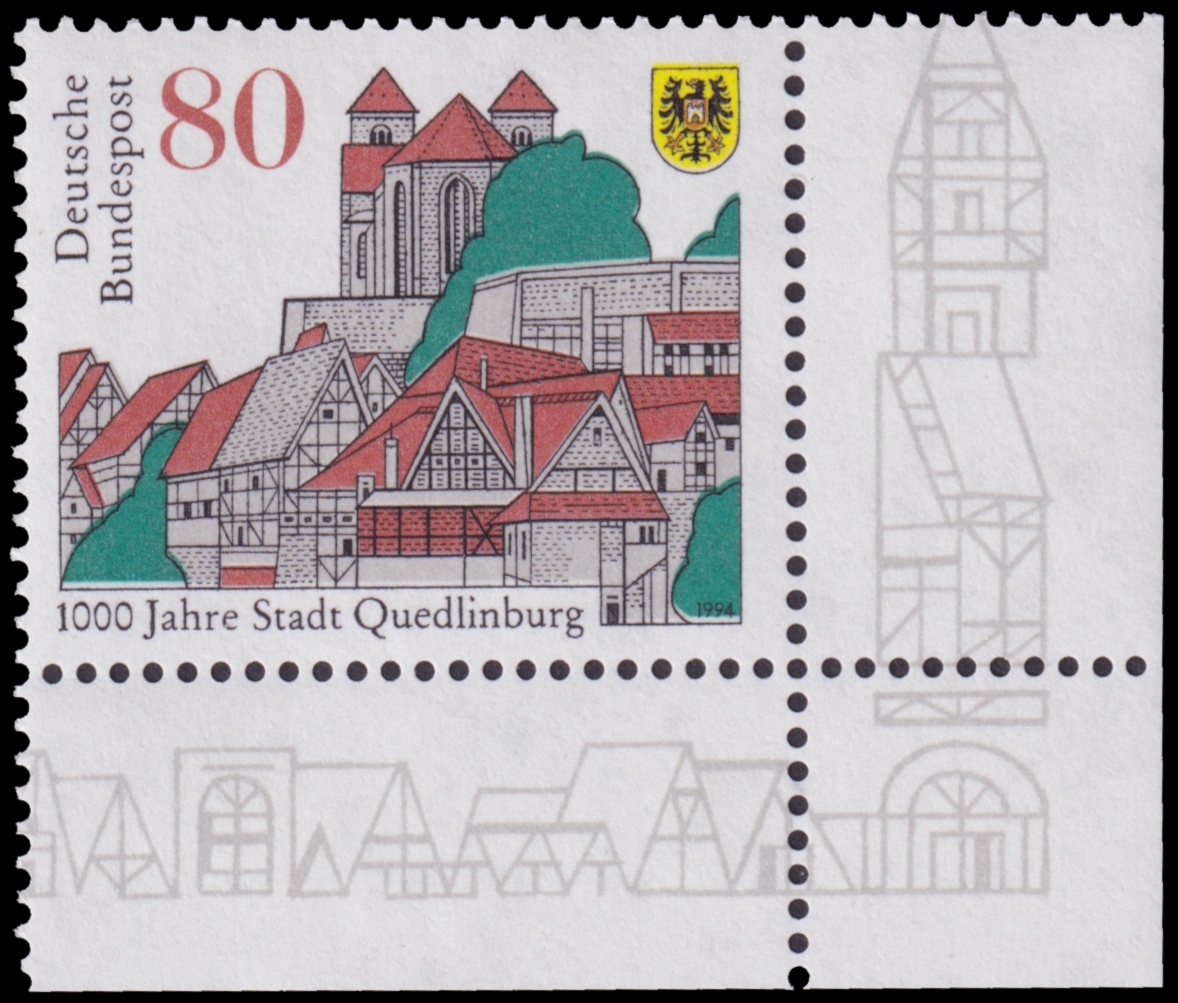
Quedlinburg on a stamp of Germany 1994, MiNr: 1765, Scott: 1871. The stamp depicts the historic Quedlinburg castle complex. The site is associated with the history of the Quedlinburg find, whose fragmented remains were reportedly kept there under the custody of Princess-Abbess Anna Sophia I. |
According to contemporary and subsequent reports, the surviving bones were kept in the abbey castle (Stiftschloss) under the custody of Princess-Abbess Anna Sophia I.
Some of the bones later entered the private cabinet of curiosities of Gottfried Adrian Müller, who served as the abbey's captain (Stiftshauptmann) from 1759 to 1763.
The bones were subsequently dispersed, with individual pieces being acquired by collectors. The Quedlinburg find nevertheless remained an important subject in the literature on the supposed fossil unicorn and later became the basis for attempts to reconstruct and interpret the mysterious skeleton.
Discussions about origin of horns of unicorn (1666)
 |
|
Johann Lorenz Bausch (1605-1665). Image credit: Wikipedia. On January 1, 1652, in Schweinfurt, Bausch, adopting the epithet "Jason I.", founded the Academia Naturae Curiosorum (Academy of Natural Curiosities) together with his colleagues Johann Michael Fehr, Georg Balthasar Metzger, and Georg Balthasar Wohlfahrt. This institution is known today as the German Academy of Natural Scientists Leopoldina. It is one of the earliest scientific associations in Europe and the oldest academy in the world still in existence. Bausch led the society he had initiated, serving as its first president from the day of its founding until the end of his life. |
In De unicornu fossili ad normam & formam Academiae Naturae-Curiosorum schediasma (An Essay on the Fossil Unicorn According to the Rule and Form of the Academy of Nature's Inquirers), published in 1666, Bausch discussed reports concerning so-called unicornu fossile (“fossil unicorns”) from various parts of the German-speaking lands. Among the historical reports he cited was a discovery made in Schwäbisch Hall in 1494. Referring to Annales Suevici by Martin Crusius, Bausch described the object as something “long and without branches” (longum sine ramis). He did not, however, identify it in this passage as a mammoth tusk or assign it to any particular fossil species.
Bausch discussed different theories concerning the origin of these “fossil unicorns”. He noted that the structure of some specimens resembled that of an elephant's tusk and that some scholars had consequently proposed an elephant origin. Nevertheless, Bausch himself rejected this interpretation and regarded the unicornu fossile as a mineral formation produced within the earth. He associated it with the concept of lusus naturae (“sport of nature”) and with the formation of minerals in the subterranean “womb” of the earth, referring to the mineralogical tradition represented by De Natura Fossilium by Georgius Agricola.
Bausch distinguished the supposed fossil unicorn from the unicorn of his own time, which he identified with the narwhal and its long tusk. He argued that the fossil specimens differed from narwhal tusks in their physical properties and morphology. They were described as exceptionally hard, dense, and solid, while some were heavily curved and hollow rather than straight and spirally ridged. In this respect, Bausch noted their resemblance to elephant tusks.
 |
|
Hannibal's army crossing Alps on elephants on stamp of Guyana 1992. The famous Carthaginian general stems from the Second Punic War (218–201 BCE), during which Hannibal Barca launched a daring invasion of Europe by marching an army, including 37 war elephants, across the Iberian Peninsula, through southern Gaul, and over the formidable, snow-covered Alps into Italy. While most of his elephants famously perished during the brutal winter crossing and subsequent battles, the memory of this military feat lingered for centuries. As a result, when early modern naturalists unearthed massive, unidentified bones and tusks across Europe, they frequently attributed them to the remnants of Hannibal’s legendary army rather than recognizing them as native, prehistoric megafauna. |
Bausch considered such explanations problematic. Elephants were not native to northern and central Europe, yet objects identified as unicornu fossile were reported from numerous regions, including the Harz, Moravia, Silesia, Thuringia, Saxony, Hesse, Swabia, Switzerland, and Franconia. He questioned how Hannibal's elephants could account for such a wide geographical distribution and why the objects were found deeply embedded in the earth rather than scattered on the surface. He also observed differences between the fossil specimens and the tusks of living elephants.
According to Bausch's reasoning, an animal capable of carrying a skull with such an enormous horn would have had to be of extraordinary size - "comparable in size to a massive ocean-going merchant ship". He therefore rejected the elephant explanation and concluded that the unicornu fossile, whatever the form of the individual specimen, represented a distinctive mineral formation generated within the earth.
The first published paleontological reconstruction in Germany (1704)
 |
|
Fountain of Klagenfurt on stamp of Austria 1968 MiNr.: 1256, Scott: 696. |
In a study published in 1840, the same year that the first adhesive postage stamp, known today as the Penny Black, was issued in Great Britain, paleontologist Franz Unger (1800–1870) identified the skull as belonging to an Ice Age woolly rhinoceros, which he called Rhinoceros tichorhinus Cuvier (now Coelodonta antiquitatis), rather than to a mythical dragon.
The earliest surviving reconstruction of a prehistoric animal in Germany dates to 1704, when Michael Bernhard Valentini published a reconstruction of the Quedlinburg “unicorn” in his Museum Museorum. In the third volume, Chapter 30, entitled Von dem wahren und gegrabenen Einhorn (“On the true and fossil unicorn”), Valentini presented several aspects of the unicorn tradition, including a two-legged reconstruction of the supposed unicorn from Quedlinburg. He identified the specimen as a Unicornu fossile and stated that the skeleton depicted had previously been found near Quedlinburg and subsequently described by Johann Meyer, an astronomer and chamberlain of city.
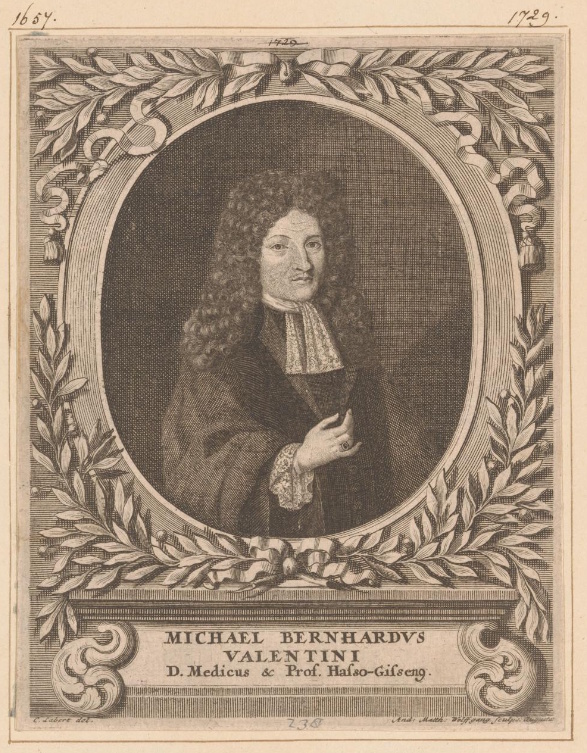 |
| Michael Bernhard Valentini, portrait engraving by Andreas Matthäus Wolfgang after Christoph Labhart, 1701. Rijksmuseum, Amsterdam, RP-P-2022-4364. Public domain. Rijksmuseum collection. |
He studied medicine at the University of Giessen and received his medical degree there in 1686. After travelling through France, the Netherlands, and England, he returned to Giessen, where he became professor of physics in 1687 and professor of medicine in 1697. He maintained extensive scholarly contacts and was a member of several learned societies, including the Academia Naturae Curiosorum (later the Leopoldina), the Berlin Academy of Sciences, and the Royal Society of London. In 1728 he was appointed imperial personal physician.
His best-known work, the extensive Museum Museorum, was first published in Frankfurt am Main in 1704 and subsequently expanded, with the final volume appearing in 1714. It brought together information on natural specimens, medicines, minerals, plants, animals, curiosities, and collections, incorporating reports and observations from scholars, physicians, travellers, and collectors. The work reflects the increasingly international exchange of natural knowledge in the late 17th and early 18th centuries.
 |
| Unicorns represented by Michael Bernard Valentini in Museum Museorum, published in 1704. |
- Unicornu officinale – the "medicinal unicorn horn", represented by a narwhal tusk;
- Unicornu marinum – the sea unicorn, represented by a narwhal;
- Unicornu fictitium – the fictitious unicorn, represented as the traditional horse-like animal with a single horn;
- Unicornu fossile – the fossil unicorn, represented by the reconstructed Quedlinburg skeleton.
He questions the existence of the traditional four-legged, horse-like unicorn, noting the large number of supposed "unicorn horns" found in treasuries, churches, and apothecaries despite the animal's supposed rarity. He also questions the exaggerated medicinal powers attributed to these horns, particularly their alleged ability to counteract powerful poisons.
Valentini then discusses the Unicornu fossile, describing fossil teeth and horns found in various regions, including the Harz Mountains, Hesse, the Palatinate, and Württemberg. He notes that their nature was disputed: some regarded them as petrified remains of animals or giants, while others considered them natural stone formations. Valentini mentions that Dr. Johann Bauhin supported the latter interpretation in his Tractatus de Unicornu Fossili, but leaves the question open for further investigation.
The Altdorf Vertebrae (1692–1708)
The fossils of the Ice Age Megafauna were not the only fossils that puzzled early naturalists. |
 |
| Johann Jakob Scheuchzer on the cachet and commemorative postmark of Switzerland 1977 | Ichthyosaur vertebrae from book of Johann Jakob Scheuchzer, published in 1708. |
In his Piscium querelae et vindiciae, published in Zürich in 1708, Scheuchzer illustrated two of the vertebrae and interpreted them as fossilized human remains, associating them with the Biblical Flood.
 |
| Johann Jakob Baier (1677-1735). Image credit: Wikipedia. |
 |
| Platypterygius ichthyosaur on commemorative postmark of Germany 2005 |
 |
| Ichthyosaur vertebrae (Nr. 32, 33) from book of Johann Jakob Baier, published in 1708. |
The correspondence between Scheuchzer and Baier represents one of the earliest documented scientific debates over the origin and identity of fossil vertebrate remains. The Altdorf specimens are also among the earliest documented records of Mesozoic marine reptiles from Germany.
René Descartes and the Mechanical History of the Earth
 |
| René Descartes on stamp of France, MiNr: 1864, Scott: 1944. |
In his Principia philosophiae (Principles of Philosophy), published in 1644, Descartes presented a hypothetical account of the formation and structure of the Earth.
In the fourth part, De Terra (“On the Earth”), he attempted to explain the Earth's present structure as the result of natural physical processes rather than simply describing it as a fixed creation.
Descartes imagined the early Earth as a hot body that gradually developed its present structure through cooling and mechanical processes. He discussed the formation of the Earth's layers, the origin of mountains and valleys, and the development of the oceans and other surface features. His account was highly speculative by modern standards, but his attempt to explain the Earth's formation through natural physical processes contributed to a new way of thinking about the history of the Earth.
Although Descartes did not specifically focus on fossils, this mechanical approach became part of the intellectual background to later geological and natural-historical theories of the late 17th and early 18th centuries, including the work of Gottfried Wilhelm Leibniz and his Protogaea.
Gottfried Wilhelm Leibniz and Another Reconstruction of the "Unicorn" of Quedlinburg (1716/1749)
In 1685, the Elector of Hanover, Ernst August, commissioned his court historian Gottfried Wilhelm Leibniz to write a comprehensive history of the House of Brunswick to advance the family's dynastic ambitions.
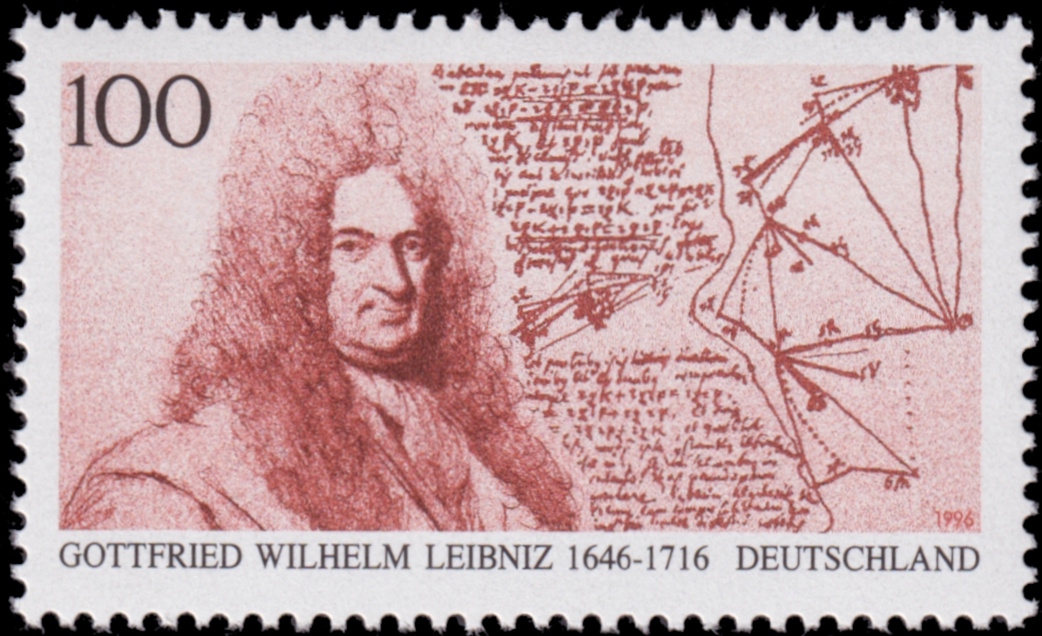 |
| Gottfried Wilhelm Leibniz on stamp of Germany 1996, MiNr: 1864, Scott: 1944. |
His interests, however, extended far beyond mathematics. He was fascinated by the history of the Earth and by the evidence preserved in rocks and fossils. He investigated minerals, geological formations, and natural processes, seeking to explain the development of the Earth through observation and reason.
Between 1691 and 1693, as a preface to his planned history of the House of Brunswick, Leibniz drafted Protogaea.
Originally conceived as a natural history of the region around Lower Saxony, it developed into a much broader investigation of the formation and history of the Earth, including rocks, minerals, fossils, and geological processes.
 |
| Title page of the Protogaea by Gottfried Wilhelm Leibniz, written in Latin. |
Leibniz argued that many fossils were the petrified remains of actual living organisms rather than lusus naturae (“sports of nature”). A similar view had been advocated much earlier by the French naturalist Bernard Palissy in his Discours admirables (1580), in which he recognized many “petrified” objects as the remains of once-living organisms. Leibniz emphasized the striking similarity between fossils and living animals, noting that different species of fish could be recognized from their stone impressions. Fossils therefore became evidence of a buried natural history that could help reconstruct the Earth's past.
Leibniz's position on fossils had developed over time. In an earlier manuscript he had apparently questioned their organic origin, partly for theological reasons, but by the time of Protogaea he accepted the organic nature of many fossil remains. At the same time, he did not accept the transformation of one species into another. Although he considered the possibility that some creatures might have adapted to changing environments, he rejected the idea that terrestrial animals had evolved from aquatic ancestors, arguing that this conflicted with Scripture.
Leibniz also proposed that the Earth's surface had been profoundly transformed by slow natural processes. The forces operating within the Earth, together with the action of fire and water, had gradually shaped its rocks, strata, and landscapes. In this respect, Protogaea presented the Earth as a dynamic body whose present condition could be understood through its geological history.

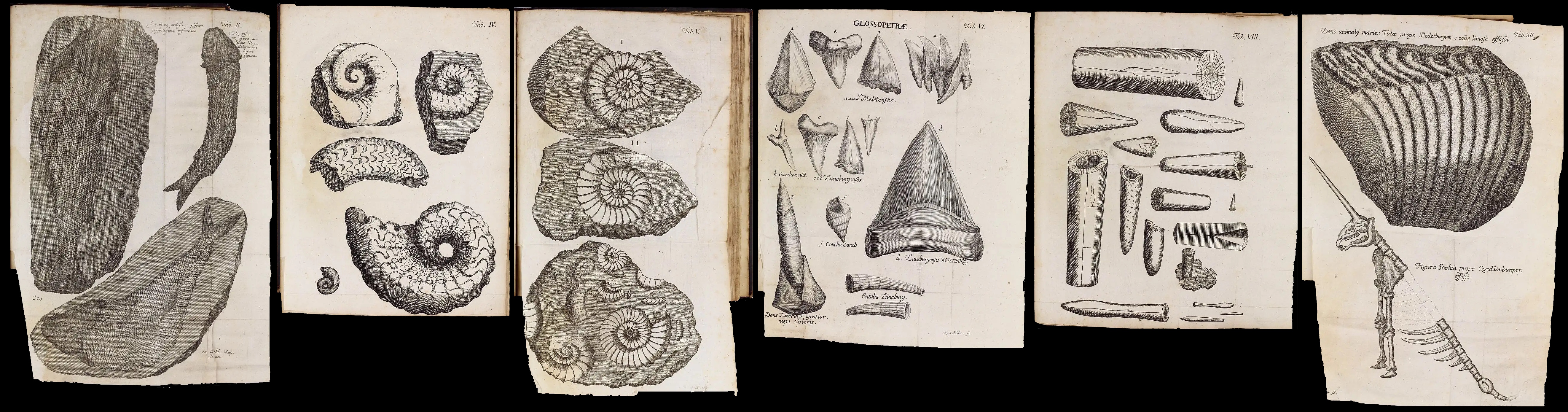
The final Plate, XII, combines two fossil subjects.
The upper image shows a mammoth molar from Thiede near Stederburg, identified in the Latin caption as Dens animalis marini Tidae prope Stederburgum e colle limoso effossi (“Tooth of a marine animal excavated from a loamy hill near Stederburg”). The reference to a “marine animal” reflects the difficulty early naturalists faced in explaining large fossil remains found far inland.
The lower image depicts the reconstructed skeleton from the Quedlinburg find, with the caption Figura Sceleti prope Qvedlinburgum effossi (“Figure of a skeleton excavated near Quedlinburg”).
Leibniz reported that he had received a written account and a drawing of the discovery and incorporated them into the manuscript. The report and original drawing appear to have originated with Johann Meyer of Quedlinburg. Leibniz and the engraver Nicolaus Seeländer later modified and completed the reconstruction. The engraving became the best-known historical representation of the Quedlinburg “unicorn”.
 |
|
Quedlinburger Unicorn comparison of reconstructions from: (a) Valentini, 1714, (b) Leibniz 1749, (c) Rust, 2002, (and (d) new interpretation). The “Unicorn” seem to have been composed of (e,f) two different Eemian interglacial Ice Age megamammals such as the straight-tusked elephant Palaeoloxodon antiquus (“horn” = tusk), and the horses Equus ferus fossilis/przewalskii (skull, front legs, anterior vertebral column and sternal bones), which explains the “horse-like” Unicorn reconstruction. (g) Unicornus fossilis illustration as a horse-like animal with narwhale horn (from Topsell, 1658 "Courtesy of Special Collections, University of Houston Libraries. UH Digital Library") and (h) new illustration based on the reconstruction of (by George “Rinaldino” Teichmann) The figure is from Diedrich, C. G. (2021). Unicorn “holotype” skeleton from the Late Pleistocene spotted hyena den site Sewecken-Berge (Germany). Acta Zoologica, 00, 1–70. >https://doi.org/10.1111/azo.12392 |
Valentini's 1704 illustration is a raw, blocky, and direct copy of the original crude sketch by local official Johannes Meyer, serving as a simple archival record of a strange local curio. In contrast, Leibniz's 1749 plate is a highly stylized and dynamic transformation. Leibniz smoothed out the disjointed bone fragments, giving the creature a more mammalian, upright posture and a sweeping horn to present it as a cohesive, biologically plausible animal structure.
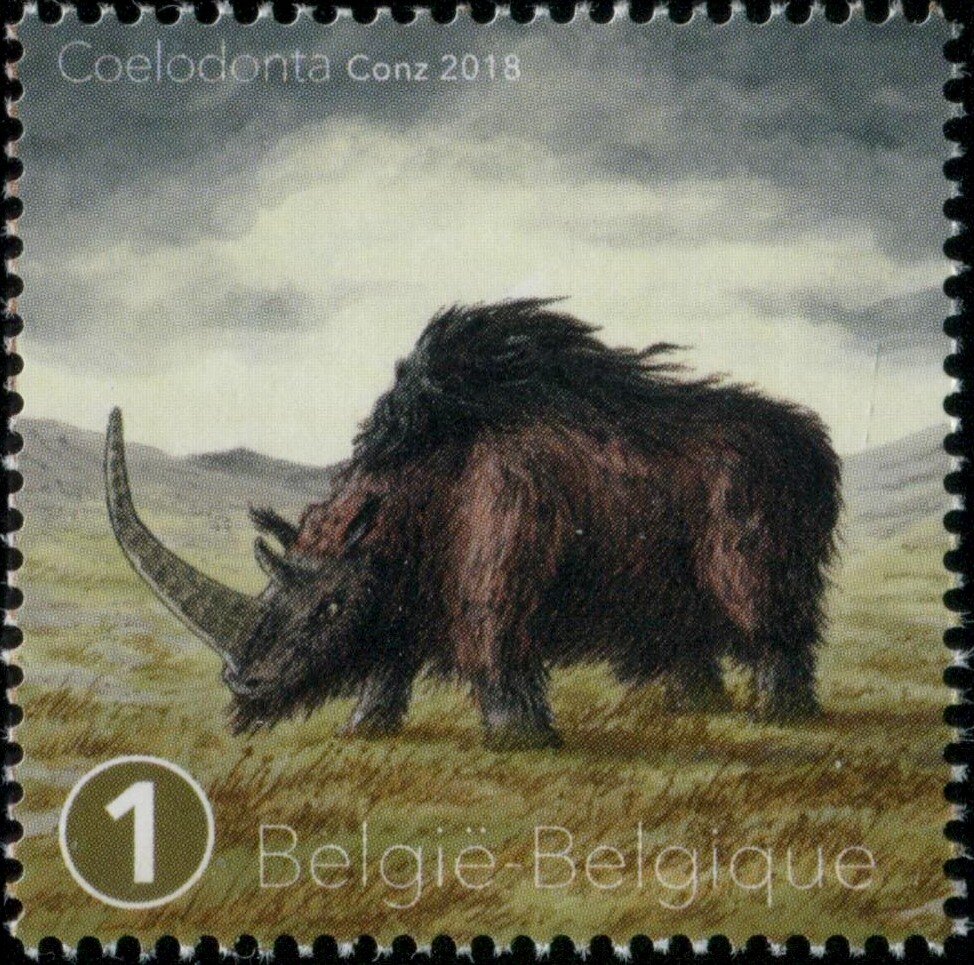
After the publication of the book, several scientists scrutinized this "Quedlinburg Unicorn" reconstruction and noted that its strange skull and fragmented bones heavily resembled those of a rhinoceros. However, because the field of historical biogeography was still in its infancy, these early researchers were at a total loss to explain how a tropical rhinoceros could have ever existed in the cold climate of Germany.
Today, paleontologists agree that the fossil skeleton is a composite created from the bones of multiple different Ice Age animals. Modern analysis demonstrates that the fossil configuration is a chimeric composite assembled from separate megafauna elements:
- The massive shoulder blades and leg bones of a woolly mammoth (Mammuthus primigenius)
- The skull of a woolly rhinoceros (Coelodonta antiquitatis) or a horse
- The straight horn is probably a narwhal (Monodon monoceros) tusk—a young narwhal has a straight and smooth surface, without spiral grooves. Others suggest it may have been a tusk from a straight-tusked elephant, Palaeoloxodon antiquus, or even a tusk of a woolly mammoth if the tusk was broken up badly enough that the people who reassembled it had the freedom to make it any shape they wanted.
- The origins of the other unicorn bones, such as the ribs, remain unclear.
 |
 |
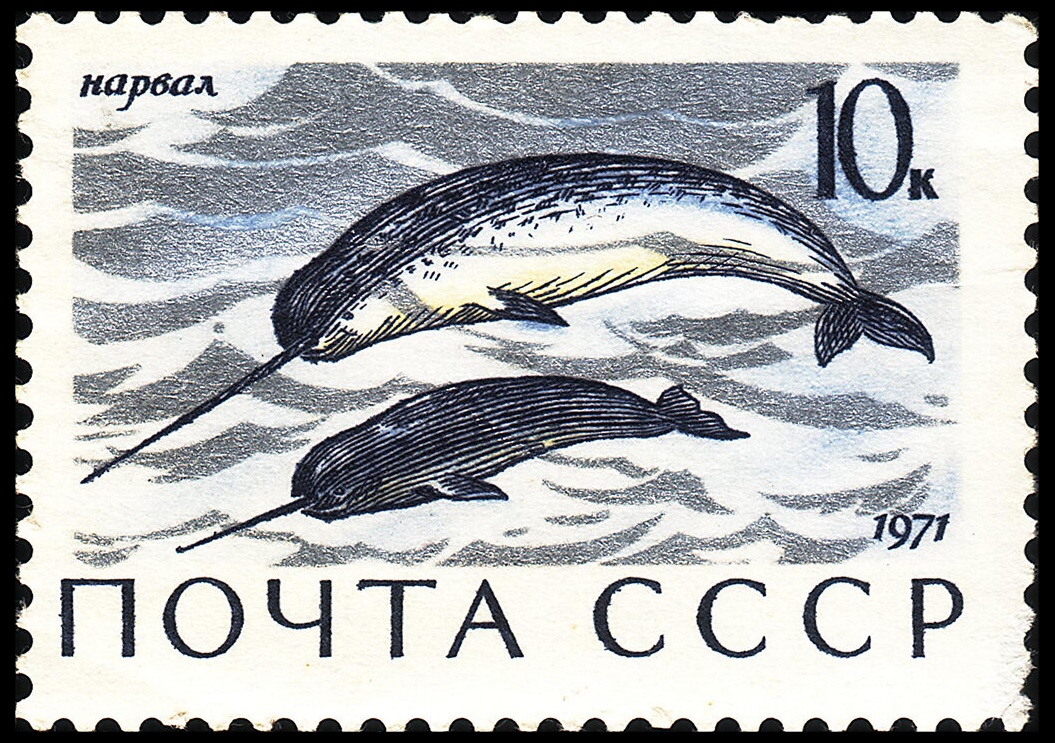 |
| Skeleton of woolly mammoth on imprinted personalized stamp of Germany 2015 | Woolly rhinoceros on stamp of Belgium 2018 | Adult and young narwhal on stamp of USSR 1971 |
Recognition of the So-Called "Fossil Unicorn" as Elephant Remains
By the end of the 17th century, fossil remains were increasingly being considered as possible remains of once-living organisms rather than merely as mysterious objects or curiosities. Nevertheless, scholars continued to interpret such discoveries within the intellectual and theological framework of their time. These developments helped prepare the way for the more systematic recognition of extinct animals and prehistoric worlds during the 18th century.
A significant episode in this changing interpretation came with the discovery of fossil elephant remains at Burgtonna in Thuringia in 1695.
The Dawn of Comparative Anatomy: Burgtonna and Wilhelm Ernst Tentzel (1696)
In 1695, workers digging sand near Burgtonna unearthed the massive remains of a large prehistoric animal, including an enormous tusk measuring about 2.4 meters in length, several large molars, and numerous skeletal bones. Reflecting the popular folklore of the era, the local excavators initially misidentified the strange, tusk as the horn of a legendary "fossil unicorn" (unicornu fossile). The unusual scale of the remains immediately attracted widespread public attention.
 |
| Friedenstein Castle in Gotha on stamp of Germany 2018 |
Various explanations were proposed, including the possibility that they represented a biblical giant or a lusus naturae ("sport of nature"). The Collegium Medicum of Gotha became institutionalized in the debate by direct order of Duke Friedrich II of Saxe-Gotha-Altenburg. Because specialized fields like paleontology and geology did not yet exist, state-appointed medical doctors were considered the highest academic authorities on organic anatomy and chemical mineralogy. Upon learning of the bizarre discovery, the Duke ordered the massive bones to be brought to Friedenstein Castle and tasked his sovereign board of court physicians with issuing an official report.
 |
| Wilhelm Ernst Tentzel (1659-1707). |
Eager to defend the era's mainstream scientific consensus—which held that the Earth's climate had remained completely static since creation—the council aggressively rejected the notion that tropical megafauna could have ever existed in Germany. They argued instead that the bones were of mineral origin, growing directly within the soil in a manner reminiscent of the conclusions reached by Johann Lorenz Bausch in 1666, some three decades earlier.
However, Wilhelm Ernst Tentzel (1659–1707), the ducal court historiographer of Saxe-Gotha-Altenburg, approached the discovery with a more systematic method. He compared each of the fossil bones with the corresponding skeletal elements of a modern elephant, drawing on the detailed anatomical description of a living elephant published by the Irish physician and anatomist Allan Mullen in 1682, as well as the classical observations of Aristotle and Pliny, and the structural insights of modern naturalist John Ray.
 |
| Asian elephant (Elephas maximus) on stamp of Bangladesh 1977 |
The Irish physician and anatomist Allan Mullen (1653-1690) examined and dissected the carcass, making detailed observations of its skeleton and internal anatomy. His account was sent to the Royal Society and published in 1682 as An Anatomical Account of the Elephant Accidentally Burnt in Dublin. The dissection, described by the Royal College of Surgeons as the first dissection of an elephant in the British Isles, provided European scholars with an important anatomical reference for later comparisons with fossil elephant remains.
Tentzel therefore considered that the presence of an elephant in Thuringia required a general cause, which he explained through the Biblical Flood. Although this interpretation remained firmly rooted in the intellectual and theological framework of the late 17th century, his use of comparative anatomy represented an important step toward the systematic identification of fossil vertebrates.
 |
| Gottfried Wilhelm Leibniz on stamp of Germany 1980, MiNr: 1050, Scott: 1329. |
Tentzel's systematic methodology quickly drew the attention of Europe's learned elite,
involving Gottfried Wilhelm Leibniz directly in the international discussion
via an intense scientific correspondence.
Intrigued by the Thuringian discovery, Leibniz used Tentzel's meticulous notes to expand the
geological and biological theories he was compiling for his own treatise, Protogaea.
Remarkably, Leibniz noted to Tentzel that
"changes have taken place in the elephants themselves" —
suggesting that these ancient creatures were structurally better adapted to cold northern regions
than their modern counterparts.
This profound insight provided early hints toward evolutionary adaptation, helping Leibniz bridge
the conceptual gap between living species and the petrified monuments of nature.
 |
 |
| Palaeoloxodon antiquus on stamp of Nevis 2005, MiNr: 2096, Scott: 1450c. | Woolly mammoth (Mammuthus primigenius) on stamp of Jersey 2010, with its molar on attached label |
Tentzel's interpretation was not immediately accepted, however. The controversy surrounding the Burgtonna fossils illustrates the gradual transition from traditional explanations of unusual fossil remains toward interpretations based on anatomical comparison and geological evidence.
A second elephant skeleton was discovered near Burgtonna in 1799, only about 15 metres from the site of the famous 1695–1696 discovery. The skeleton was found in a compressed and bent position and occupied approximately 6 metres. Its two tusks were about 3 metres long and had fallen from their sockets. Although much of the material was fragile and several bones crumbled during excavation, portions of the lower jaw, large molars, tusks, and other bones were preserved and carefully described. By 1799, there was no longer serious doubt that the Burgtonna remains belonged to an elephant. The principal questions had shifted to the age of the animal and its place in the history of the Earth. The Burgtonna discoveries therefore marked an important transition from identifying fossil remains to investigating their geological age and the existence of extinct species.
References
The Creationist Milieu: Early Natural History and Biblical Narrative
The Mammoth Tusk of Schwäbisch Hall
|
|
|
Cabinets of Curiosities and Court Collections
| Cabinet of curiosities | Staatliche Kunstsammlungen Dresden |
Johann Bauhin (1541-1613) |
Castle/Abbey Banz |
The "Unicorn" of Quedlinburg (The Magdeburg Unicorn)
- Wikipedia
- Natura History Museum of Magdeburg
- Philosophy Now
- LWL Landesmuseum (Das Einhorn von Quedlinburg – Zwischen Mythos und Archäologie)
- T. van Kolfschoten · A. Hesse · The Woolly Rhinoceros from Seweckenberge near Quedlinburg
- "DISCOVERING THE MAMMOTH - A Tale of Giants, Unicorns, Ivory, and the Birth of a New Science", by John J. McKay, published in 2018, ISBN: 978-1-68177-424-4. Pages 41-44.
- "Mammoth Tales" blog of John J. McKay - "Leibniz's Unicorn", from 3 June 2013
Personalities
|
Johann Meyer (1607–1665) |
Michael Bernhard Valentini (1657-1729)
|
Otto von Guericke (1602-1686)
|
Gottfried Wilhelm Leibniz (1646-1716) |
The Altdorf Vertebrae
| Johann Jakob Scheuchzer (1672–1733) | Johann Jakob Baier (1677–1735) |
Burgtonna and Wilhelm Ernst Tentzel
Mammoth fossil of Burgtonna
|
Wilhelm Ernst Tentzel (1659–1707)
|